


News
BNR's live studio from the European Parliament in Strasbourg
"Strasbourg Calling" MEP Gordan Bosanac: Croatia is one of the countries with the highest inflation
The weak economy and poverty of the population were the main challenges in entering the eurozone
Friday 11 July 2025 07:29
Friday, 11 July 2025, 07:29
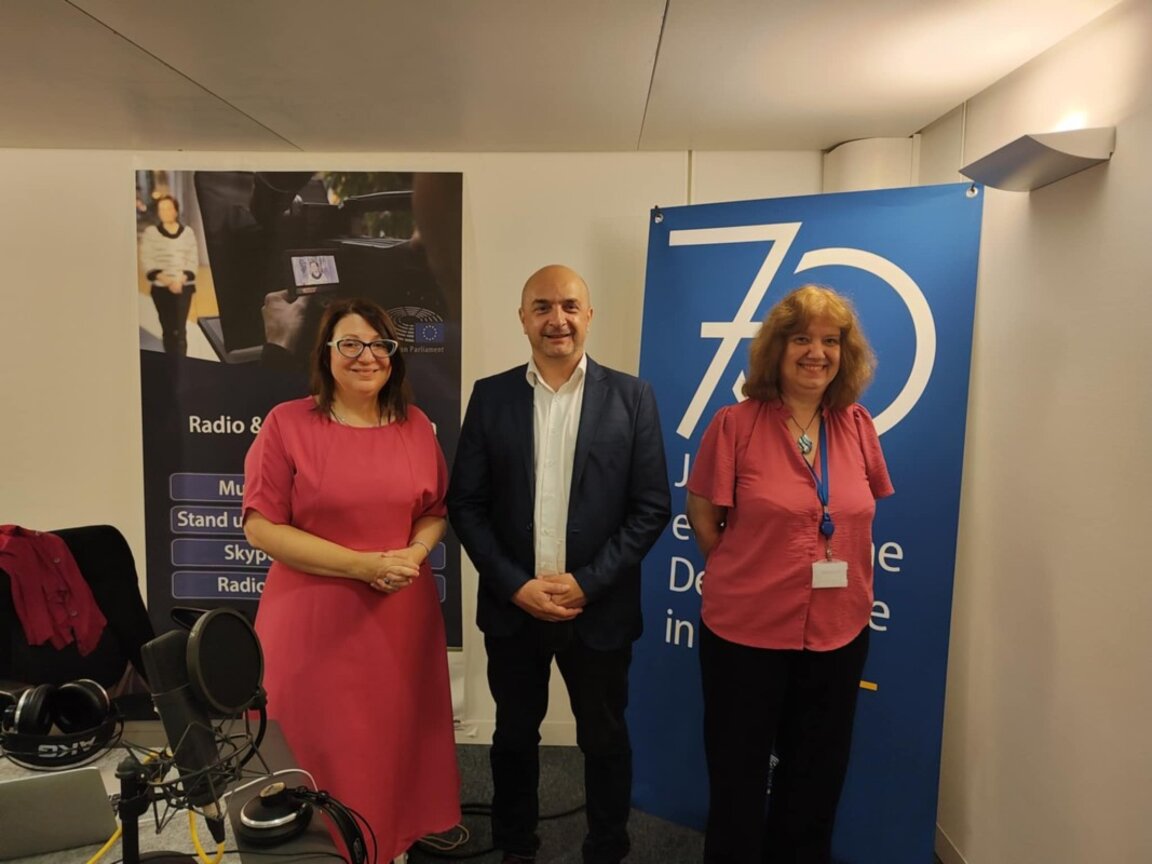
MEP Gordan Bosanac with BNR's Irina Nedeva and Angelina Piskova
PHOTO Rositsa Petkova
Font size
The main challenges in introducing the euro in Croatia were the weak economy and poverty of the population. This was said in an interview with the Bulgarian National Radio by Croatian MEP Gordan Bosanac from the group of the Greens/European Free Alliance, member of the Committee on Regional Development.
Croatia became a EU member in and in 2023 became the 20th member of the Eurozone. Before that in July 2020, Bulgaria and Croatia joined the European Exchange Rate Mechanism (ERM II).What is Croatia's experience from the Eurozone accession, what have been the main challenges the country face in the process?
"The role of the euro was not such a crucial game changer, the more important was the moment when Croatia entered the European Union, because after we entered the EU we started to see better economic results and after we entered the Eurozone we began to see the rise in prices", MEP Gordan Bosanac said for the BNR in an interview at the European Parliament in Strasbourg.
The rapid increase of prices after adopting the euro was due more to the heavy inflation, not to joining the eurozone, the MEP expressed his opinion.
What were the reasons for this high inflation in Croatia?
"There are different theories, but I am closest to the one that the prices in large supermarkets were increasing because of the will of the owners of the big shops because when we looked at the profits of the big supermarkets, they were incredibly high. We think that they earned the most from the inflation and they were actually pushing the inflation. We think they used the situation with the euro to make mess, saying that the prices will go up also because of the euro but the truth was actually that they were increasing the prices of the products because of their profits", MEP Bosanac said.
When comparing prices, for example, for the same tomato, chocolate and flowers in the same shop in Italy, Germany, Austria and Croatia, people could not explain why there was such a huge difference in prices, double difference, given the goods came from the same place, Bosanac explained.
The government tried to control the inflation by introducing a freeze on prices of basic products, but as the low-priced products quickly ran out, people were forced to buy the more expensive alternative, Bosanac added.
"Unfortunately, we are still struggling. Croatia is still one of the EU member states with the highest inflation rates. Our government has still not found an answer to this problem and this huge economic shift", said MEP Bosanac.
The government has increased public sector wages, but this has further fueled the price hike, according to MEP Gordan Bosanac.
Read also:
- "Strasbourg Calling" EP President Roberta Metsola: The euro means security and stability
- "Strasbourg Calling" EP Vice President Sabine Verheyen: The European Media Freedom Act has nothing to do with censorship
English publication: Rositsa Petkova
This publication was created by: БНР екип