


Author
Ivo Ivanov
News
Civil rights in the focus of relations with Turkiye, Serbia and North Macedonia
Bulgaria and the Balkans – part 2
Tuesday 30 December 2025 11:05
Tuesday, 30 December 2025, 11:05
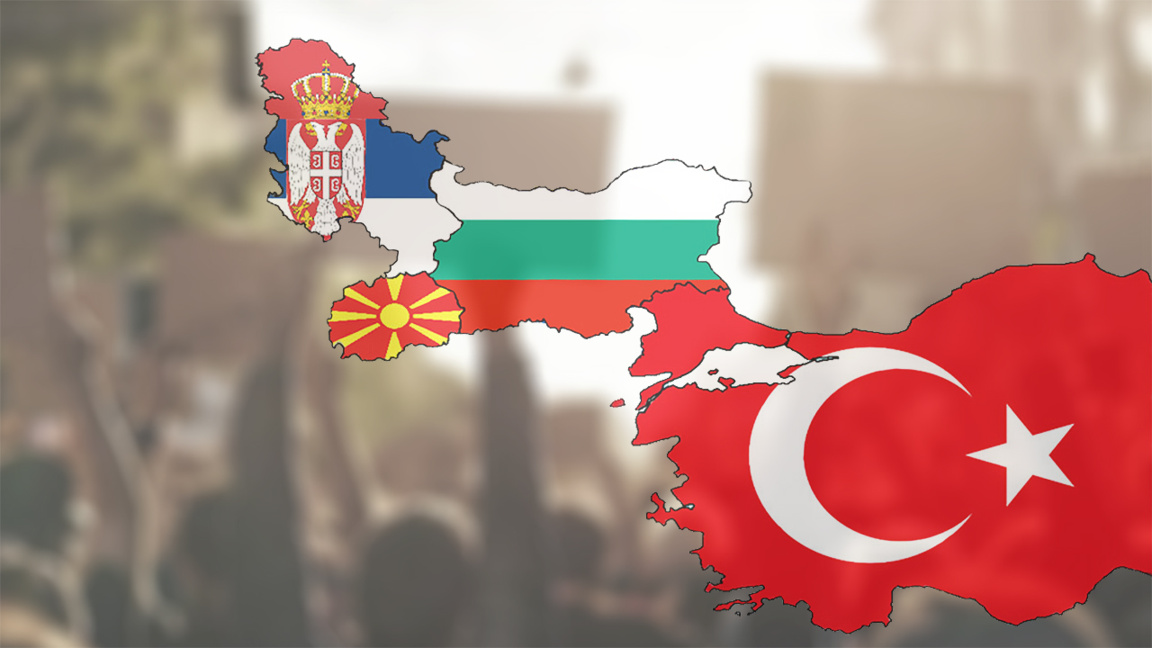
PHOTO Photocollage Ivan Petrov
Font size
Our overview of Bulgaria’s bilateral relations in the Balkans in 2025 continues with a look at Turkiye, Serbia and North Macedonia – all of them countries where there are historically-formed Bulgarian diasporas who are now relying on active diplomacy on the part of Bulgaria for preserving peace, European integration but also for protecting human rights.
As military actions escalate in the Black Sea, the neighbouring countries members of the EU Bulgaria, Romania and Greece have been working actively to preserve peace and understanding in the Balkans, to build roadways and energy highways along the North-South axis. That is why, being a NATO ally, Turkiye’s value in asserting the architecture of peace in the region has been growing.
It will take active diplomacy to alter the BOTAS gas agreement
Ankara is emerging as an increasingly important strategic partner to the EU and the Western allies.

Mehmed Yumer
PHOTO BTA
“As challenging as Erdogan may be, he is an unavoidable factor for his European partners. From this angle that applies in full to Bulgaria as well – Sofia pursues a consistent approach in its policy towards Ankara. Governments change but the policy remains the same, with no abrupt about-turns. What stood out during the outgoing year was the protection of human rights. Because in Turkiye, the observance of human rights really did deteriorate,” Mehmed Yumer, journalist at obzornews.bg comments for Radio Bulgaria. In this context he highlights the visit by Sofia Mayor Vassil Terziev to Silivri to support the arrested Mayor of Istanbul Ekrem Imamoglu.

Vassil Terziev
PHOTO Facebook/VassilTerzievZaSofia
“What Terziev said at the time was that the prison in Silivri is holding captive more than the mayor of Istanbul, but also the will of millions of Turkish citizens. That was a very powerful nuance in the relations between the two countries,” says Mehmed Yumer and goes on that that this was a coordinated effort by the mayor of Sofia and the network of major European cities Eurocities. Sofia refrained from any independent public reaction to human rights in Turkiye, keeping up its good relations with the country, and on the other hand, Bulgaria continues to play a balancing role in Europe’s relations with Turkiye,” Mehmed Yumer explains.
Economically, the event of the year between Bulgaria and Turkiye is the gas delivery agreement saga between the Turkish state company BOTAS and the Bulgarian company Bulgargaz, he says. “The feeling left from this whole controversy is that somehow Bulgaria really may be paying for something it is not consuming,” says Yumer and adds that “Turkiye should also display good will with regard to this agreement. But whether it will do so is a question of diplomacy” and the emergence of other realities in 2026.
On the whole, the Bulgarian minority did not join in the protests in Serbia
2025 in neighbouring Serbia was dominated by civil protests targeted against the administration. What was the position taken by the Bulgarian community in the country, concentrated mostly in the Easternmost regions, frequently described as the poorest parts of Serbia?

Biser Banchev
PHOTO BNR
"The national communities in Serbia, at a leadership level, are generally strictly controlled by the Serbian state. This is a tradition going all the way back to royal Yugoslavia,” Dr. Biser Banchev, researcher at the Institute of Balkan Studies at the Bulgarian Academy of Sciences, says in a comment on the citizens’ protests in neighbouring Serbia in 2025. “Generally speaking, the protests never affected the nucleus of the Bulgarian minority. On the whole, the municipal councilors and the activists of the political parties followed the model set down by their parties. The activists of the opposition parties supported the protest but there are not that many of them. For their part, the local activists from the ruling coalition supported President Aleksandar Vucic.”
The Bulgarians in Serbia, who have endured so much at the hands of Belgrade, did not join in the protests in any great numbers because they do not believe that any changes in state policy towards the ethnic minorities are possible, whoever may be at the helm, Dr. Banchev explains and goes on to describe the attempt by Aleksandar Vucic to associate Bulgaria with an “anti-Serbian military union” between Croatia, Albania and Kosovo as “preposterous”.

Silent protest in Caribrod in memory of the victims in the Novi Sad tragedy
PHOTO FB/internet.portal.far
“Actually, as it turned out, it was neither a union, nor was it military, it was just an agreement on military technical cooperation. That is so absurd that it even raised eyebrows among the Bulgarian diplomats,” adds Dr. Biser Banchev in an interview with Radio Bulgaria.
The tragedy in Kocani is the event that brought together Bulgaria and North Macedonia
“The time passing between North Macedonia and Bulgaria cannot be measured in years. The measure is inappropriate,” says journalist Vladimir Perev in an interview with Radio Bulgaria. From the perspective of his 80 years, he sees the relations between Sofia and Skopje in the light of the, as yet unresolved human rights issue of the Macedonian Bulgarians.

Vladimir Perev
PHOTO BGNES
“In any case, a positive event during the year, to the utmost regret of us all, was the tragedy in Kocani where 63 young people lost their lives in the disastrous fire at a nightclub. The entire European community offered and provided help. But the help of Bulgaria and the Bulgarian people was invaluable. And we are not talking about ambulances or an air ambulance here. We are talking about the commitment of the whole of Bulgarian society to welcome the wounded from Kocani and their families as a form of support for their medical treatment. That became a clear example of solidarity and national unity between North Macedonia and Bulgaria. The long, seemingly endless lines of volunteers waiting to give blood at the emergency hospital Pirogov were a demonstration of the unbreakable unity of the fate of the people, bound by blood, family and friendship,” says Vladimir Perev in an interview with Radio Bulgaria.

The blood donation drive at Pirogov hospital in Sofia after the tragedy in Kocani
PHOTO redcross.bg
Going back to the human rights issue, the journalist goes on to enumerate the efforts of Bulgarians in Macedonia, over the space of more than one century, to acquaint the world with the violation of their human rights in the former Yugoslavia, and describes the visit, in October 2025, of a small group, headed by himself, to the Council of Europe, as a follow-up of these petitions. In Strasbourg, together with Georgi Crnomarov and Hristian Pendikov, they acquainted the European officials with the realities in North Macedonia today.
Despite the physical assault the journalist suffered in Skopje at the end of the year, Vladimir Perev remains optimistic about 2026. He says he believes the Bulgarian authorities and diplomacy are the key factor for the development of democratic relations in the Balkans, and most of all between North Macedonia and Bulgaria.
Translated by Milena Daynova
This publication was created by: Milena Daynova