


Author
Diana Tsankova
News
An exhibition fitting into 1 cubic centimeter will travel to the Moon
"A Book for the Moon” featuring 48 international artists will be presented exclusively at the Episcopal Basilica in Bulgaria's Plovdiv
Monday 23 February 2026 14:29
Monday, 23 February 2026, 14:29
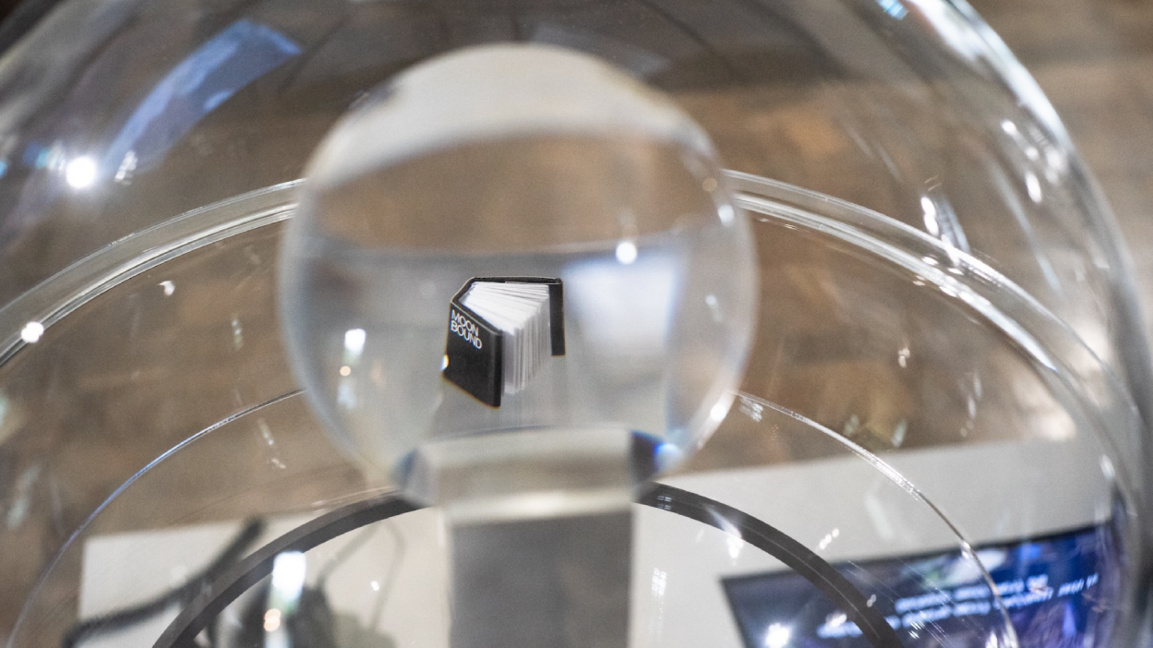
PHOTO Evan Lorenzen
Font size
Twenty-eight works of art contained within 1 cubic centimeter, and 48 creators from around the world exploring humanity’s relationship with the Cosmos through contemporary space art. And all of this - in a single book built around one question that changes everything: “How does the Moon see the Earth?”
The Early Christian Episcopal Basilica of Philippopolis in Bulgaria’s second biggest city Plovdiv will offer a possible answer on February 23, when it unveils “Moon Bound – A Book for the Moon”. Its 80 pages bring together texts and images printed with a precision of 5,760 pixels per inch. Space art here goes beyond paintings of astronauts or science fiction illustrations - it considers the Cosmos as an equal partner in the creative process.
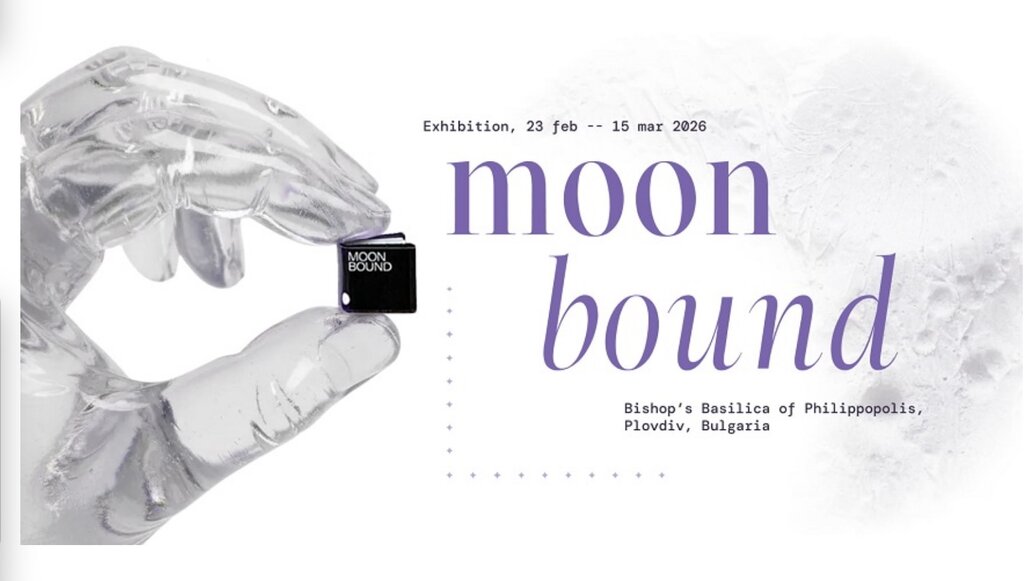
PHOTO Facebook/Association “Plovdiv Project Center”
“This miniature actually contains questions that will determine our future in outer space and in space science - namely, which moral paradigms travel beyond our planet, and whether cultural artifacts beyond Earth can shape our vision of the future as a civilization,” says Ivelina Kadiri, project manager and deputy chair of the association “Center for Projects - Plovdiv,” one of the organizers.
Through their works, the artists seek to draw attention to preserving and safeguarding the integrity of our planet. Dutch artists Jeroen van der Most and Peter van der Putten present an AI-simulated dialogue between Earth and the Moon, in which the highest lunar peak addresses its earthly counterpart:
“Dear Everest,
They come, they mark, and disappear. You remain. The wind silences their echoes, time swallows their names. Stone outlives breath. Light heralds the next morning. I observe, you wait.
Mons Mouton”.
From the perspective of a mountain peak on the Moon, all people are one whole.
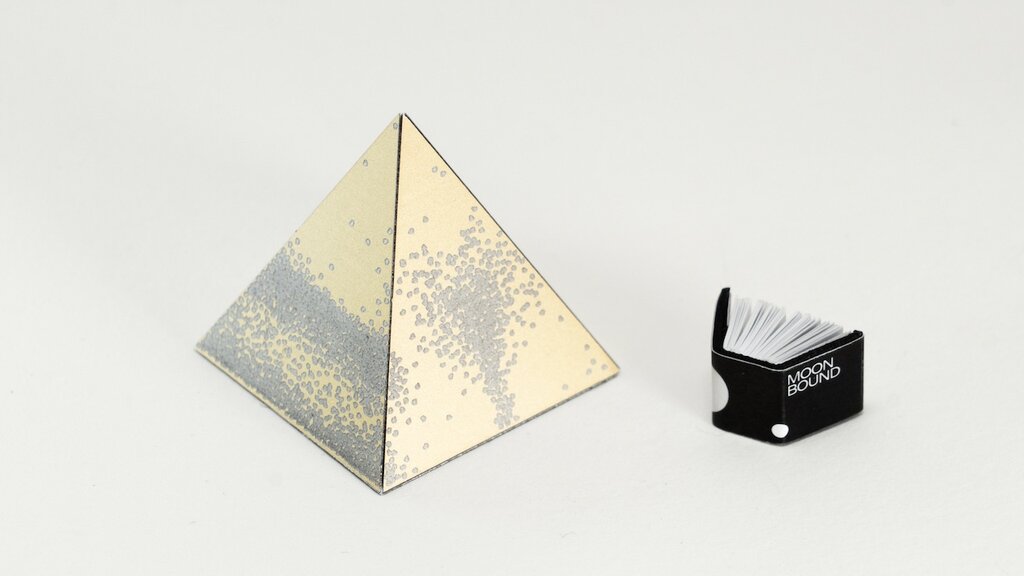
PHOTO Evan Lorenzen
“By turning our gaze inward, we realize we cannot answer the question of our responsibilities toward the Cosmos and the surrounding environment without considering non-human perspectives - mountains, matter, the enduring Cosmos, and all the names and ambitions we believe we will leave behind,” says Kadiri.
She also refers to the so-called “overview effect” experienced by astronauts in orbit - a profound shift in consciousness that transforms them as they see Earth as a boundless and fragile planet without visible national borders, where conflicts seem meaningless and humanity appears united by a shared destiny. “I believe the Moon sees exactly this - Earth as an interconnected, pulsating, living organism that must remain in harmony with what it contains.”
The idea behind “Moon Bound - A Book for the Moon”, created by the Dutch Moon Gallery Foundation, is to look at ourselves instead of looking at the Moon from Earth - to imagine how our natural satellite sees us. Artists, writers, and philosophers pose a fundamental question about humanity’s future beyond the planet:
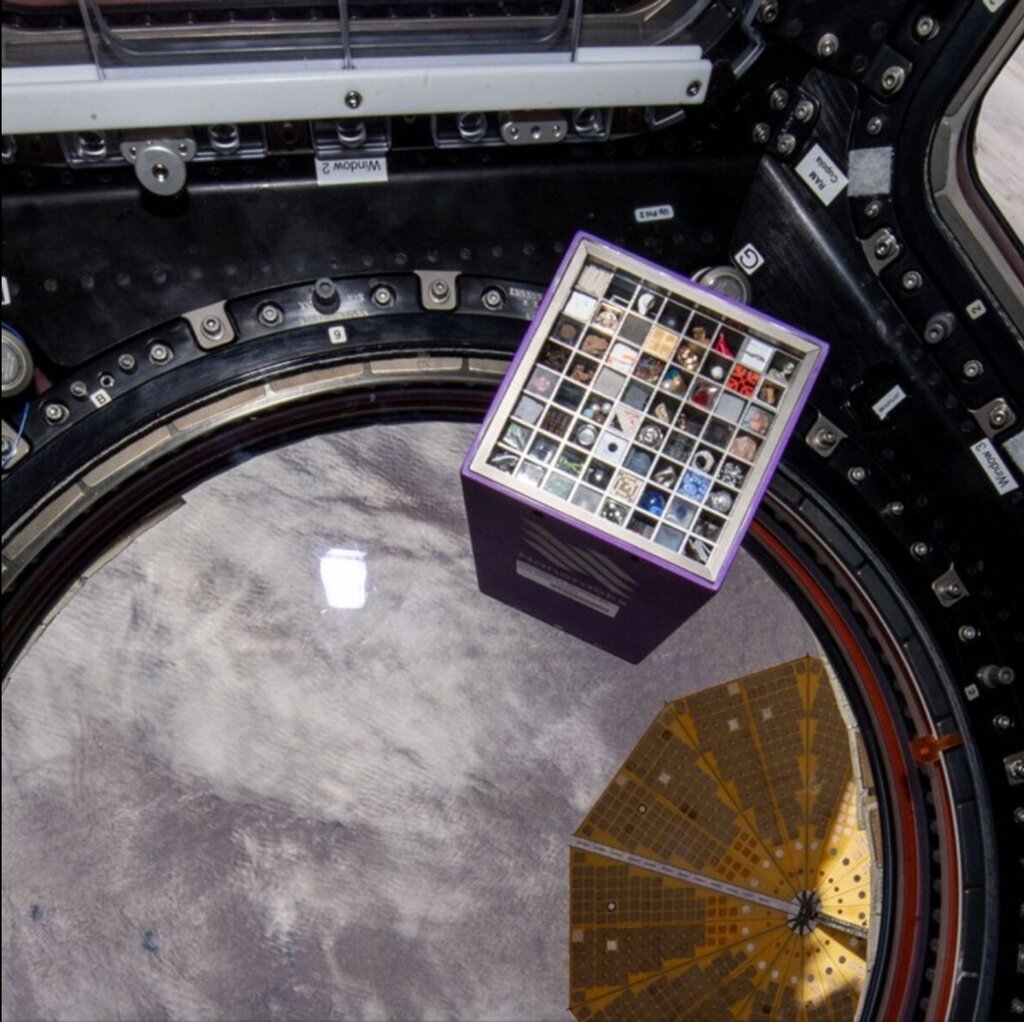
PHOTO Facebook/Association “Plovdiv Project Center”
“Which moral paradigms have the right to travel into space, when every gram matters technologically?” Kadiri adds. “In practice, this is a manifesto of human culture - what we choose to carry beyond Earth in order to avoid the mistakes of colonial history and to build the foundations of a future interplanetary civilization on principles of diversity, sustainability, and above all critical self-reflection.”
There is also a Bulgarian contribution to the exhibition in the person of Plamen Yordanov, who has lived and worked in the United States since 1998. He participates in Moon Bound with a print of his sculpture “Infinity” from his Double Mobius series.
The Episcopal Basilica of the ancient Roman city of Philippopolis, built in the 4th century, was not chosen by chance as the venue. It symbolically builds a bridge between antiquity and the legacy humanity will leave behind.
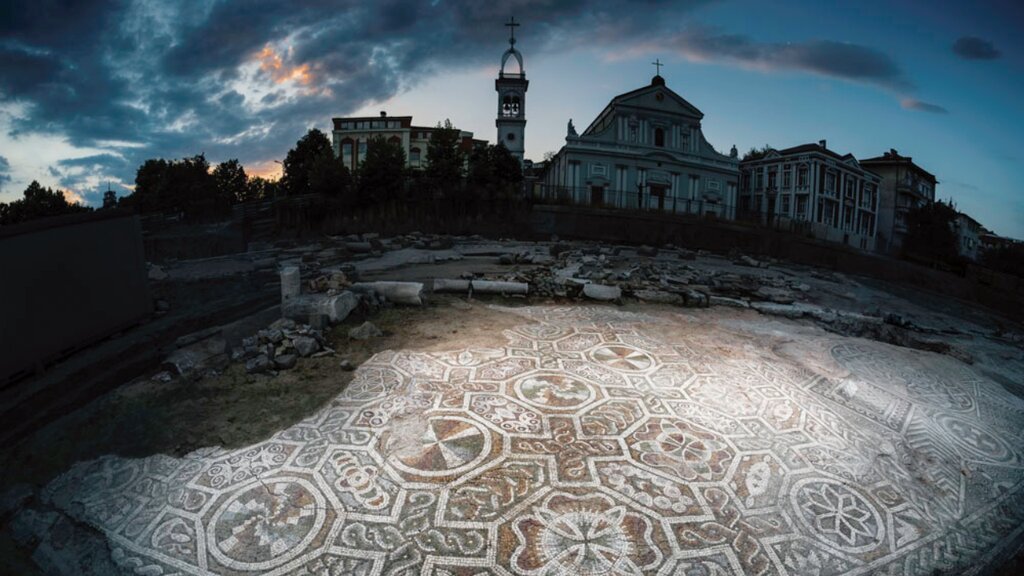
PHOTO ancientbulgaria.bg
“This is the most logical place to present a vision of the future - to make viewers grasp the depth of the message and begin asking what we leave behind,” says Kadiri. “Because, unfortunately, everything today feels ephemeral - emotions, experiences, and even our value systems are transient, and at this stage of our existence we are like wandering orphans, disconnected from spirituality, origin, antiquity, and the covenant of our ancestors.”
The ancient basilica will be the only place within Earth’s orbit where the exhibition is presented before traveling 384,400 kilometers to the Moon aboard the specially organized lunar mission Griffin-1. The miniature volume will journey on a flip rover by the company Astrobotic and is set to land at the lunar South Pole this summer, where water molecules have been discovered.
Within this symbolic time capsule - one day to be found by others - are pioneers of space art.
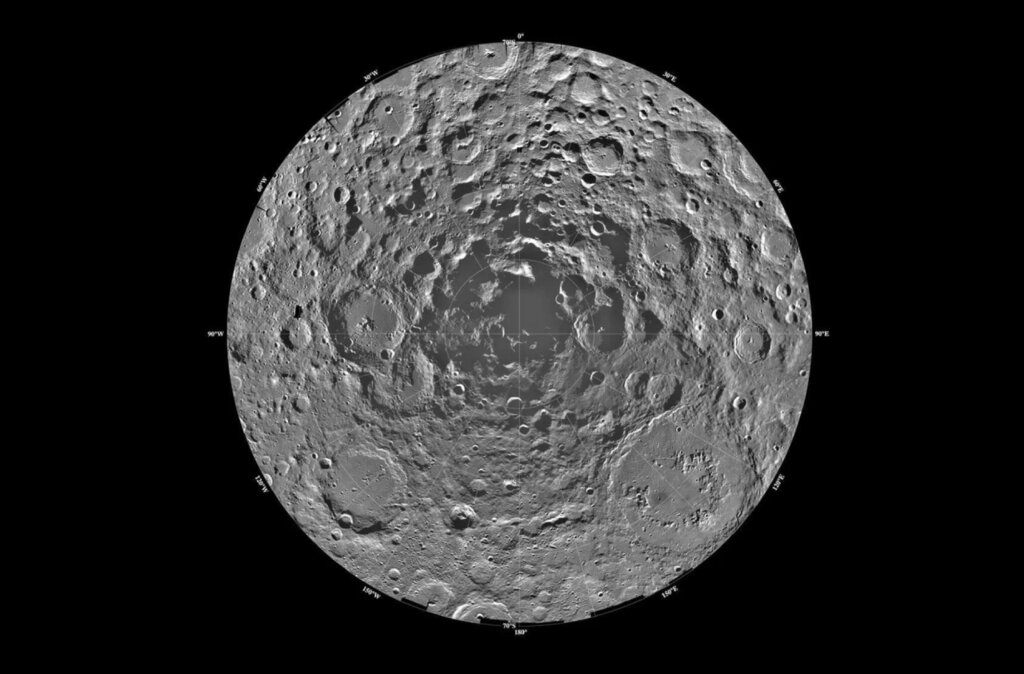
PHOTO Facebook/Association “Plovdiv Project Center”
Arthur Woods explores how sculpture transforms when freed from gravity, which dictates form on Earth. Eduardo Kac provokes reflection on inner vision and self-observation in a cosmic environment. The exhibition’s curator, Chilean-born Luis Bernardo Guzmán, examines how space technologies generate new life forms. A group of artists from Congo reveal how minerals mined in Africa for modern space technologies return as electronic waste, attached to the suit of a dreamer-astronaut - once again questioning the sustainability of technological and space exploration.
Together, they prompt us to consider what truly belongs to us and which cultural values and forms we wish to pass on to future space generations.
So what does the Moon see in the Earth?
“Both our spiritual decline as we conquer new technological heights - a paradox of modern humanity - and the beauty of our brilliant intellect, which never stops pursuing challenges, striving toward the ideal of a visionary: an architect of the future of human civilization,” Ivelina Kadiri concludes.
Edited by Elena Karkalanova
English: R. Petkova
This publication was created by: Rositsa Petkova