


News
Reading human emotions through eye movements
Bulgarian scientists develop brain implants related to diagnostics and improving the condition of patients
Sunday 5 July 2026 22:54
Sunday, 5 July 2026, 22:54
PHOTO Pexels
Font size
Recognizing human emotions and identifying people through eye movement tracking is a project that scientists from the Institute of Information and Communication Technologies at the Bulgarian Academy of Sciences work on. The scientific team includes young researcher Teodor Vakarelski, who was inspired by the idea five years ago, attending a lecture on Eye Tracking by his scientific supervisor, Prof. Kiril Andreev.
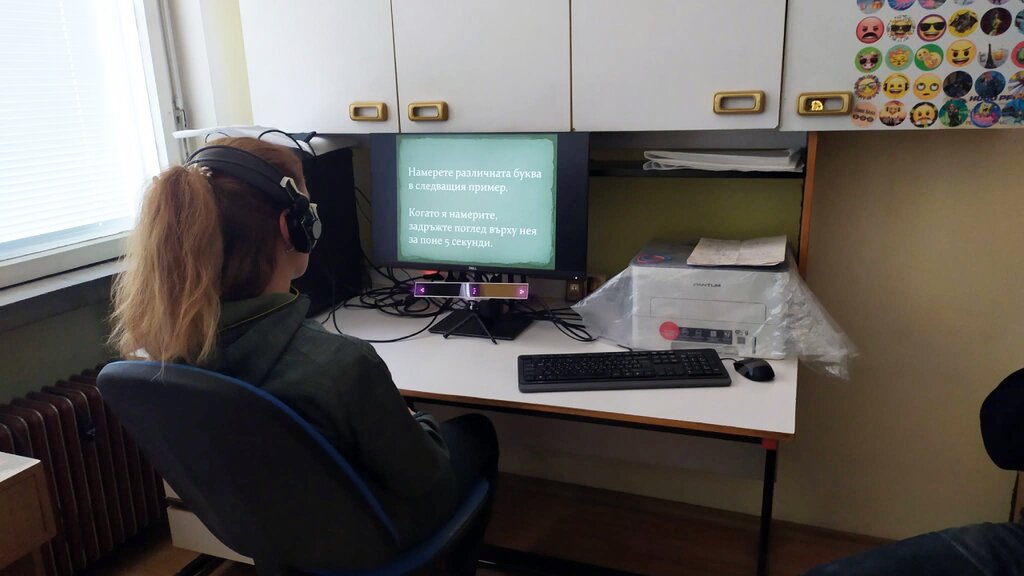
PHOTO personal archive
"What
information can we extract from eye movements - that was the initial
question we asked ourselves,” Teodor Vakarelski recalls. "In our
laboratory, we put a so-called eye tracker device on people. This
is
a high-frequency 1000 Hz camera. The camera takes a thousand pictures
per second with very good resolution and works in the infra-red
spectrum. Thanks to its extremely high accuracy, we can record and analyse even the smallest eye movements.”
During
the experiments, the volunteers had to focus on a certain point. And
although it seems that their eyes do not twitch, it turns out that
they perform three types of movements, one of which is suitable for
analysis for identification purposes. According to Teodor Vakarelski,
the method guarantees much greater security, since a fingerprint and
signature could be forged.
The
scientists' activities are part of the European VIBraTE project of
Assoc. Prof. Dimitar Prodanov with the main goal of developing and
improving deep brain implants.
Teodor Vakarelski
PHOTO личен архив
"In
this way, a brain-computer system is created, which examines the
interaction between machine and human,”
Teodor Vakarelski says
in
an interview for the "Hristo Botev" program of
the Bulgarian National Radio. “One of the sub-directions of the
project is non-invasive systems - they do not cause limitations to
the person and it is not necessary to use
a brain implant to obtain the information. This can be done with a
remote device that scans it."
For
this purpose, the institute has already built the first laboratory in
Bulgaria
for testing brain implants, equipped with an optical table that is
well isolated from environmental vibrations. There, one can simulate
pulse, breathing, various movements and study the connection between
the human brain and the brain implant. "Our goal is to create a
model with better characteristics compared to the current state of
brain implants, as they hide many dangers and imperfections,"
the scientist adds.
The
interdisciplinary research team hopes to have a final result by the
end of next year – a model that will improve the current state of
the technology and be usable.
PHOTO personal archive
"Many
diseases could be positively affected by brain implants," says
Teodor Vakarelski. "Some of the models are related to
diagnostics, others to improving the condition, but their main
application at this stage is in paralysis of the body - when the
brain functions well, but as a result of an accident, a nerve in the
spine is severed, leaving the person paralyzed. In fact, the brain
implant allows information from the brain to be taken, transmitted to
artificial intelligence for analysis, after which a cursor can be
moved on a computer screen and even an exoskeleton or wheelchair can
be set in motion, i.e. the person can be mobile."
According
to the scientist, with the help of a brain implant, it is possible to
predict when there is a risk of an epileptic shock - in such a
situation we should stop driving and lie down. Clinical depression is
also affected by electro stimulation, without causing addiction as is
the case with most medications.
Text:
Diana Tsankova (based on an interview with Ani Kostova from the
"Hristo Botev" program of
the BNR)
This publication was created by: Alexander Markov