


Author
Albena Bezovska
News
From Radio Bulgaria's best collection
Folk legends about Saint Ivan of Rila
Bulgaria’s heavenly patron departed this earthly life 1,080 years ago, on August 18
Tuesday 18 August 2026 06:25
Tuesday, 18 August 2026, 06:25
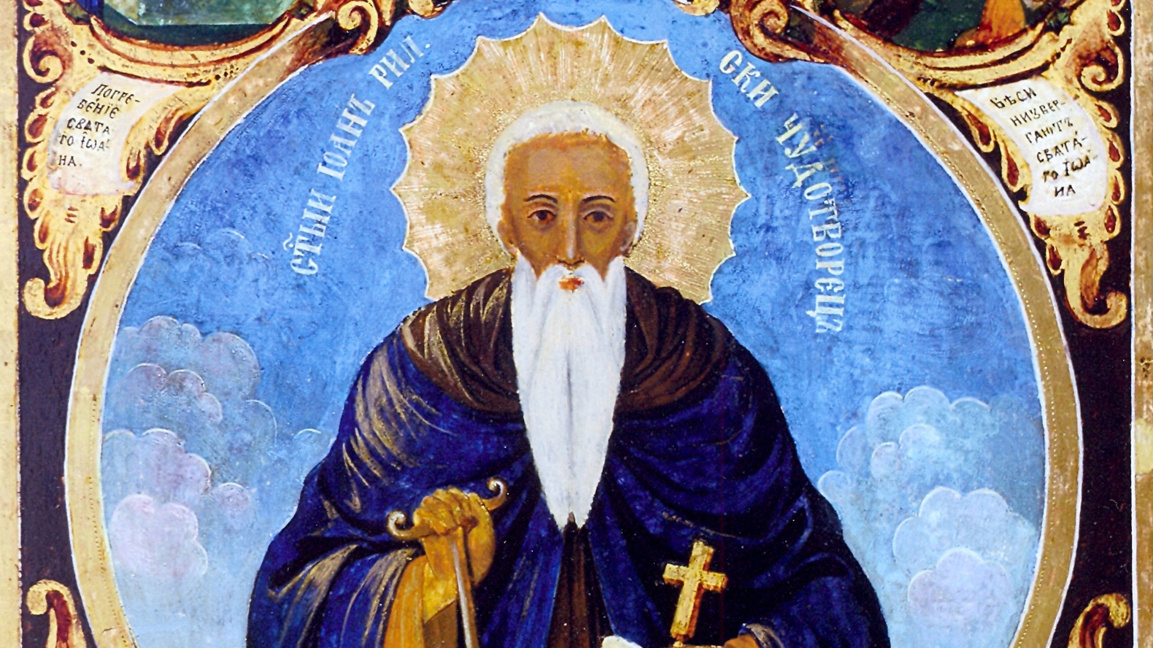
“St. John of Rila the Wonderworker” – an icon by Nikola Obrazopisov
PHOTO Historical Museum – Samokov
Font size
Orthodox Paganism or vernacular Orthodoxy refers to a truly unique aspect of our traditional heritage. Christian beliefs and folk customs coexist within it without any apparent contradiction; biblical stories unfold on Bulgarian soil, while folk songs sound like variations of church hymns. A significant part of Bulgarian oral tradition is devoted to Saint Ivan of Rila (St. John of Rila). One of the most beloved saints in Bulgaria, he appears as the central figure in numerous folk legends, tales and songs.
In folk tradition, the name Saint Ivan more often refers to John the Baptist. There are many customs associated with him, including Ivanovden (The Day of St. John the Baptist, January 7), Enyovden (Midsummer Day, June 24), and others. It is worth recalling that the cults of Christian saints began to penetrate and spread throughout the Bulgarian lands as early as the 3rd–4th centuries, before the adoption of Christianity. It is likely that even then, many of the saints’ images acquired certain characteristics of the pagan deities. In this respect, the body of legends about Ivan of Rila is relatively close to the existing hagiographies and hagiographic works.
According to church sources, St. Ivan of Rila was born in 876 in the village of Skrino, near the town of Kyustendil. He died on August 18, 946. Called even during his lifetime an “angel of the Lord” and a “heavenly dweller” St. Ivan of Rila is regarded as the heavenly patron saint of Bulgaria. The epithet Wonderworker is invariably added to his name, because of the miracles he performed during his lifetime and after leaving the earthly world. Sixteen hagiographies of St. Ivan have survived to the present day. The oldest dates from the 12th century and is known as the “Popular Life”. Researchers assume that an even older account existed, written shortly after Saint Ivan’s death. The literary sources of the “Popular Life” are unknown, but it certainly brought together the traditions about the Rila monk that were circulating at the time.
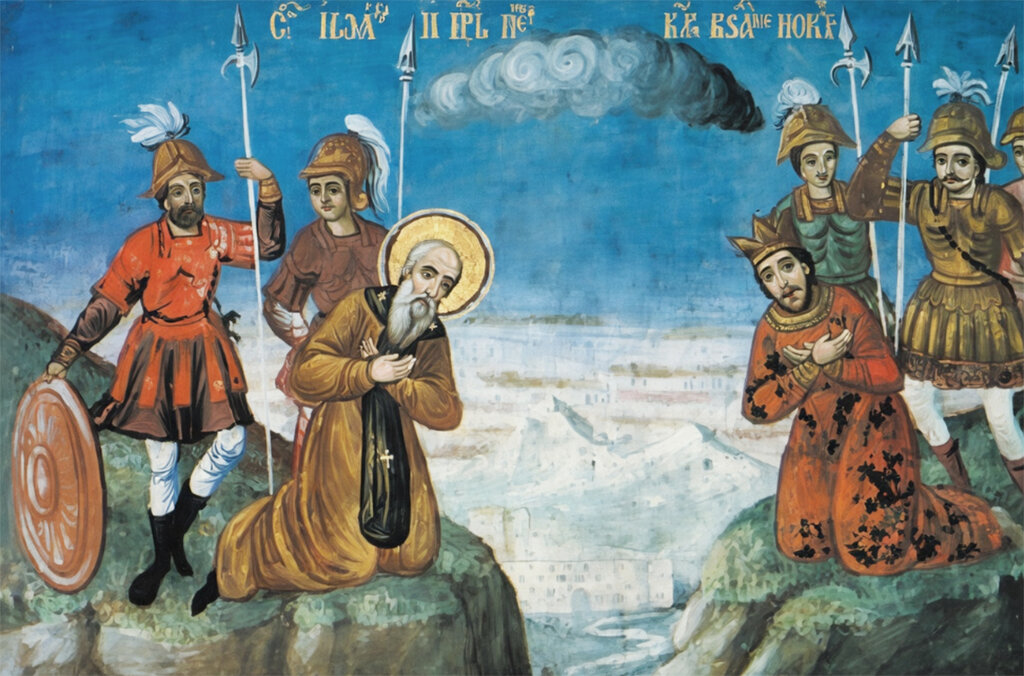
St. Ivan of Rila and Tsar Peter – mural painting
PHOTO bg-patriarshia.bg
One of the most widespread legends depicts St. Ivan of Rila as a man who renounced worldly possessions and as a miracle worker comparable to Christ himself. It tells of Tsar Peter’s desire to meet the hermit, a story that is also found in the “Popular Life.” For years, the ruler had heard stories about the miracles performed by the hermit Father Ivan. While travelling to Sredets (present-day Sofia), he decided to continue on to the Rila Mountains and find him. The tsar’s envoys searched for the monk for a long time. Eventually, they found him in front of a cave and told him why they had come. He listened to them and then invited them to share a meal with him. He had only a small piece of hard, brown bread, and the men thought they would remain hungry. Just as Christ had fed a multitude with five loaves and two fish, the saint miraculously caused the bread to be sufficient for everyone—and, remarkably, it proved to be exceptionally delicious. One of the envoys was ill, but he was instantly healed. They all returned to their ruler with joyful faces, eagerly telling him about everything they had heard and witnessed.
The tsar set out himself to see the venerable old man, but the place was difficult to reach and he was unable to do so. He sent envoys once again, and Ivan of Rila instructed the tsar to climb to the summit and light a fire there. “Everything is possible through God, not through men… Thus we were ordained to meet”, the message said. The monk also lit a fire, and a huge column of smoke rose toward the sky. Seeing the smoke from the opposite mountain, the two men praised God and bowed to one another from afar. The tsar sent a cup filled with gold. St. Ivan of Rila accepted only the cup and returned the gold. In the most widespread folkloric version of the tale, the ruler sent a large shipment of fruit, food, and a great quantity of gold. The hermit accepted the fruit but returned the gold, saying:
“Tell the tsar that I accept the fruit because it is food for the body, but I return the gold because it is poison for the soul!”
The melody of the folk song “Izraslo E Darvo Visoko” (A Tall Tree Has Grown) performed byDaniel Spasov, bears a strong resemblance to Church Slavonic liturgical music. The lyrics tell of a tall tree with silver branches and golden little bees among them. The tree itself represents Saint Ivan, the silver leaves are the holy icons, and the golden bees symbolize “God’s Christians.”
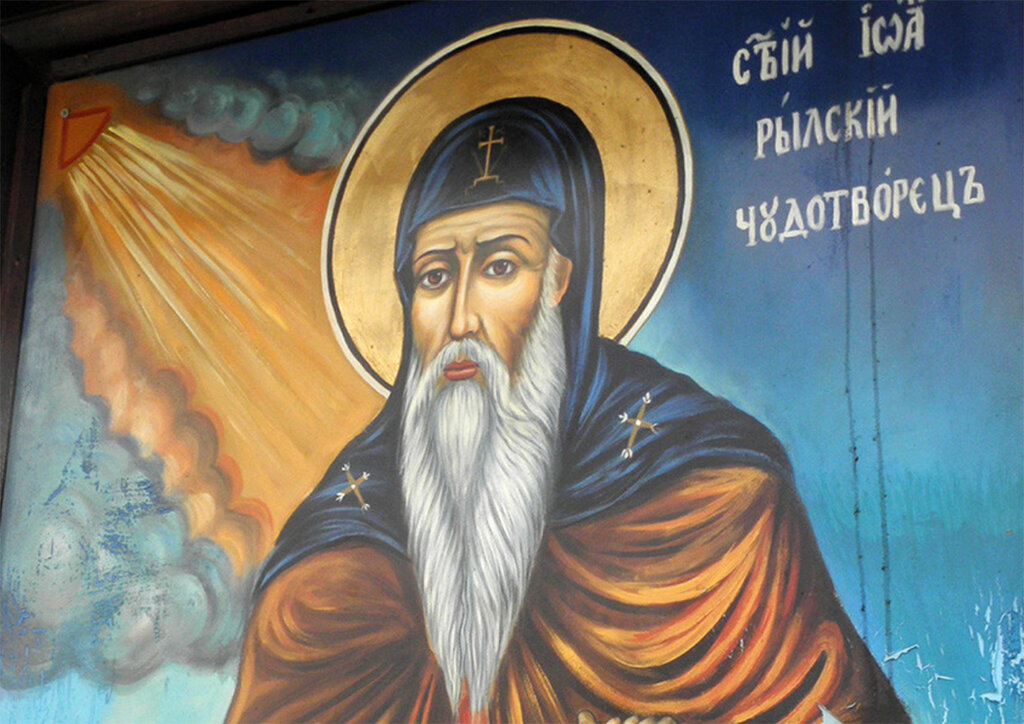
PHOTO BGNES
One of the defining features of his folkloric image is his role as a unifying figure and protector of the Bulgarian people, as well as his ability to overcome natural forces and cure illnesses.
A folk tale portrays Ivan as a child. Long ago, the boy was tending the cattle of a local wealthy landowner. One day, one of the cows crossed the river and gave birth to a calf on the opposite bank. The young herder did not know what to do, so he went to the owner of the herd for advice. The man was harsh and merciless. He ordered his young servant to bring the animals back to the herd, while hiding himself so that he could see how the boy would manage. The Struma River had risen like a sea, making it impossible to cross. Ivan then prayed to God, laid his garment upon the water, and sailed across the river as though it were a boat. In the same way, he carried the newborn calf across, while its mother followed on her own. When the wealthy man witnessed this miracle, he became frightened and told the boy that he no longer needed his services.
Depending on the folkloric region, the saint is known by different names. Besides Ivan, other forms include Yovan, Ovan, and Aliya. According to scholars, the last of these names suggests that he was attributed with the supernatural powers of the biblical prophet St. Elijah.
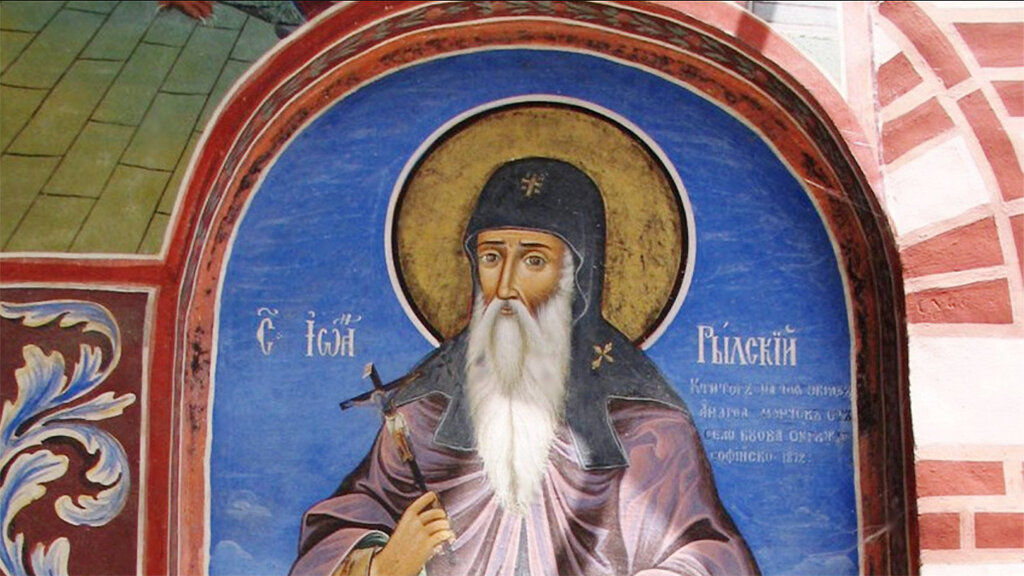
“St. John of Rila the Wonderworker” – mural painting in the Rila Monastery
PHOTO BGNES
Countless legends of miraculous healings exist at the boundary between reality and mysticism. Some of them originated in the 20th century and were recorded by Archimandrite Kliment Rilets in his book ''The Miracles of St. Ivan of Rila and the Miraculous Icon of the Holy Mother of God ‘Osenovitsa’ in Rila Monastery''. The book was published in 1946 to commemorate the 1,000th anniversary of the saint’s blessed death. It contains numerous legends and traditional accounts. Here, however, we will focus on the testimony of the renowned Bulgarian ethnographer Hristo Vakarelski. In an article cited by Archimandrite Kliment, the scholar recounts his own personal experience. As a young child, he was frequently ill, and nothing seemed to help. Someone advised his parents to take him to St. Ivan—that is, to the Rila Monastery. They took their extremely weakened child, loaded him onto a horse-drawn cart, and set off for the holy monastery. It was the eve of Malka Bogoroditsa (the Nativity of the Virgin Mary, September 8). They reached the vicinity of the monastery at dusk and stopped there for the night. They wondered how they would make the journey in the morning with a child who was too exhausted to take even a single step.
“My grandmother, not knowing what to do in her grief, cut a hazel branch, returned to the fire, and showed it to me. I took it, leaned on it, and began to walk”, Professor Vakarelski wrote. His mother immediately made a deep bow in the direction of the monastery and said: “Dear St. Ivan, you gave me back my child! Dear St. Ivan, the child is yours!” They made a vow to send him back to the monastery with offerings once he recovered. The promise was fulfilled. “There are thousands of such vows among our people, because the Bulgarian people’s faith in the miraculous power of the holy wonderworker of Rila is great”, Professor Vakarelski concluded.
This publication was created by: Kostadin Atanasov