


Author
BNR team
News
Hunger strike at BNR! When will a solution be found for BNR’s musical ensembles?
BNR Symphony orchestra conductor Konstantin Ilievsky: We are fighting to survive
Saturday 19 September 2026 07:37
Saturday, 19 September 2026, 07:37

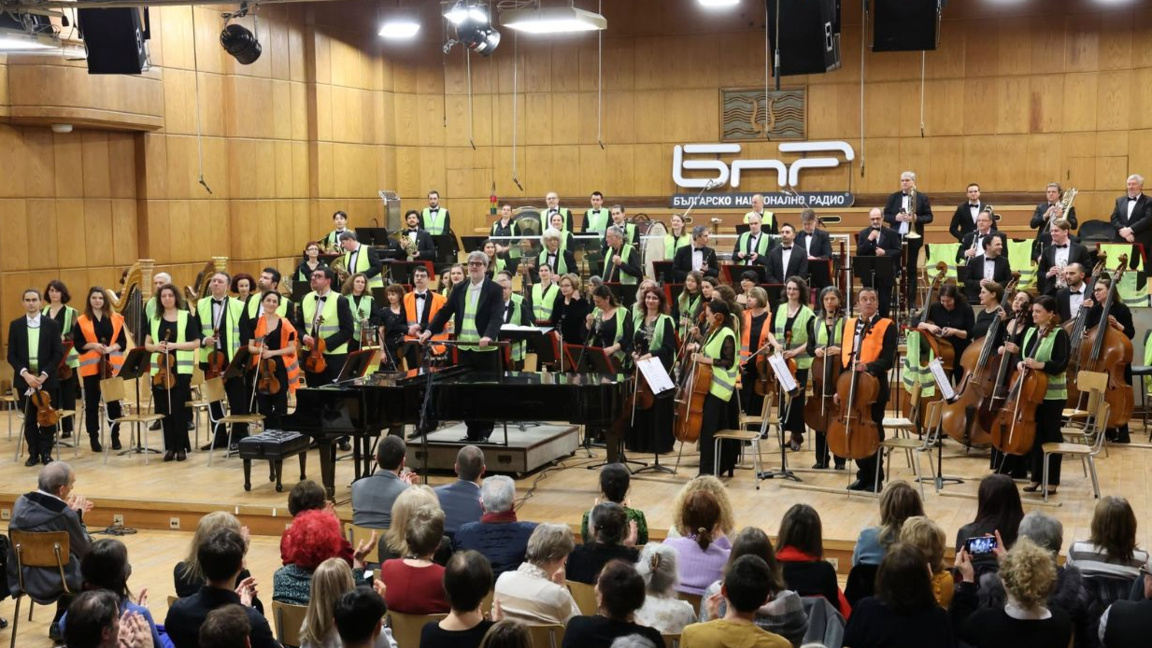
Symphony orchestra of the Bulgarian National Radio performing in Studio 1 of the BNR wearing reflective vests as sign of protest
PHOTO Ani Petrova
Font size
The musical ensembles of the Bulgarian National Radio have been protesting for more than a year over insufficient funding. Midway through the previous season, the Radio Symphony Orchestra suspended its concert activities and continued to work solely on recording projects.
BNR musicians halt concerts in protest over low pay
This week it became clear that the musicians are no longer prepared to wait indefinitely for politicians to find a solution.
First came the news that Galina Koycheva, the orchestra’s concertmaster, was leaving. A little later came an even more alarming announcement:
BNR orchestra violinist announces hunger strike over low pay
“My name is Iva Djadjeva, and I am a musician with the BNR Symphony Orchestra. After a year and a half of agony, I have taken the extreme step of declaring a hunger strike, because our orchestra is falling apart and we simply have no options left. We are desperate. We are pleading for attention!”
We have been forced to resort to these extreme measures, said composer and pianist Antoni Donchev, who served as conductor of the BNR Big Band until July this year.
“This is a problem that has been dragging on for many years, namely insufficient funding, particularly for the musical ensembles of the Bulgarian National Radio, as well as for BNR as a whole."
Slav Slavchev, solo oboist with the Radio Orchestra, outlined the musicians’ demands:
“An additional one-off allocation of €350,000 for BNR’s musical ensembles in the BNR budget for 2026. We would also like to see the Bulgarian National Radio’s budget for 2027 increased by BGN 2 million compared with the 2026 budget, with the funds earmarked exclusively for the sustainable financing and development of BNR’s musical ensembles and the gradual resolution of the structural problems that have accumulated over the years. This comes in the context of the anticipated amendments to the Radio and Television Act, which would change the status of the ensembles and establish a sustainable model for their continued existence. We genuinely expect the draft law to be submitted for public consultation by the end of September, so that we can find out what the new rules for funding public service media will actually be.”
BNR Director General Milen Mitev was adamant that one-off, stopgap measures are not viable solutions. He, too, is counting on the necessary legislative amendments being adopted by the end of September.
“The problem of the extremely low pay of musicians at the National Radio, which is part of the broader problem of inadequate funding for public service media in Bulgaria, is not a recent one. It is a problem that has existed for many years and, unfortunately, has been growing steadily and inexorably worse over time.
At present, a working group at the Ministry of Culture is nearing completion of a proposal for amendments to the Radio and Television Act. One of the envisaged changes is to regulate the status of the National Radio’s musical ensembles, define their activities and include those activities as part of BNR’s work eligible for public funding.
If this bill is adopted, it will make it possible for BNR’s future budgets to be drawn up in a way that also incorporates the activities of its musical ensembles. In my view, this is the right course of action because it will establish a lasting framework for these relations.Short-term solutions involving one-off transfers can always be implemented, but we are seeking a long-term solution. I believe that both the Ministry of Culture and the National Assembly’s Committee on Culture and Media, which are aware of this problem, will find a way to accelerate the process, including through short-term measures that would allow us to wait for the legislative changes that have been discussed and prepared for so long to finally become a reality.
The Ministry of Culture is striving to present the bill for public consultation and subsequent adoption by September 30, so that this change can be enshrined in law.”
In an interview for BNR's Horizon channel, Konstantin Ilievsky, chief conductor of the BNR Symphony Orchestra, said that the musicians were deeply concerned:
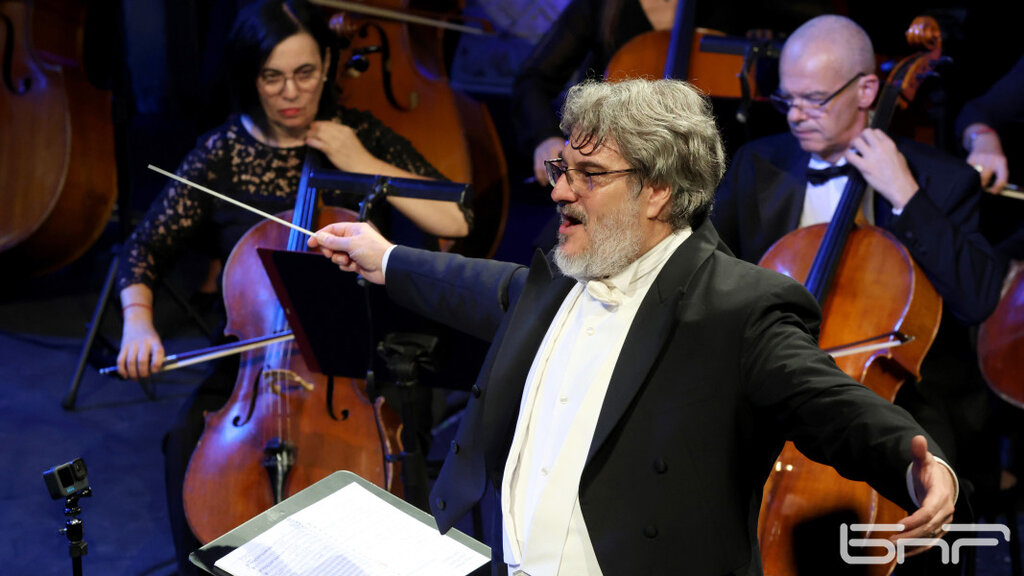
Conductor Konstantin Ilievsky
PHOTO Ani Petrova
“I think it is clear to everyone that what happened, namely the declaration of a hunger strike, is truly an absolutely extreme measure. Personally, I was extremely surprised because this is an outright last resort, signalling to the entire public that our situation is genuinely dire, and has been for a very long time.
We have been waiting for a solution to our problem for more than a year and a half. And, as I understand it, this is a problem that goes back many years, even before I joined BNR as chief conductor of the Symphony Orchestra.
Three governments have come and gone. We have been repeatedly assured and promised that work was under way to address our situation. But the fact remains that, to this day, our situation is becoming increasingly difficult.”
We are fighting for survival, Maestro Ilievsky stressed, explaining:
“For us, this is not about fighting for some exceptionally luxurious or comfortable life as people working in the arts. We are simply fighting to survive. With the salaries they receive here, my colleagues cannot afford to live in the capital, especially younger musicians who are planning or already have families and children. Some may come from outside Sofia, yet they are exceptionally talented musicians whom we need to attract to this elite ensemble and retain here. They simply cannot make ends meet. Once they have paid their rent, they have no money left for food.”
According to Ilievski, the average salary in BNR’s orchestras is well below €1,000.
“A young colleague who is left with around €700 after all deductions genuinely has no chance of making ends meet.”
In his view, the financial dimension of the problem is becoming increasingly serious and has now reached a point where it can no longer be contained.
The problem affects more than 200 people, and that number is declining as some musicians leave, Ilievski said, stressing that it is also becoming increasingly difficult to recruit new musicians.
“If our problem is not resolved, I am unfortunately afraid that the situation will continue to deteriorate.”
You can find the full interview (in Bulgarian) with Konstantin Ilievsky on BNR's Horizon channel conducted by Spas Krainin HERE.
Edited by Anastasia Krusheva
English version: R. Petkova
This publication was created by: Rositsa Petkova