


News
What are the values of modern Bulgarians?
Family, peace and financial stability are most important to Bulgarians today
Monday 5 October 2026 13:57
Monday, 5 October 2026, 13:57
PHOTO BTA
Font size
The question of what Bulgarians value most is not merely a philosophical one. Over the years, sociological agencies and research institutes, as well as international and humanitarian organisations, have explored it in an effort to gain a clearer picture of the society in which we live and the direction in which it is heading. How long is the road between the goals we set as a society and our desire for a better world for ourselves and our children?
In the spirit of human values and critical thinking, we examined some of the largest sociological surveys conducted in Bulgaria and Europe, considered their commissioners and objectives, and attempted to bring together data from the past nearly ten years to answer the question: what are Bulgarians like today and what do they care about?
The latest major nationally representative survey on the subject was conducted in September 2026 by Progress Consult, commissioned by a major German hypermarket chain operating on the Bulgarian market. The study has been conducted periodically since 2017, tracking changes in the value system of Bulgarians and the factors that determine their quality of life.
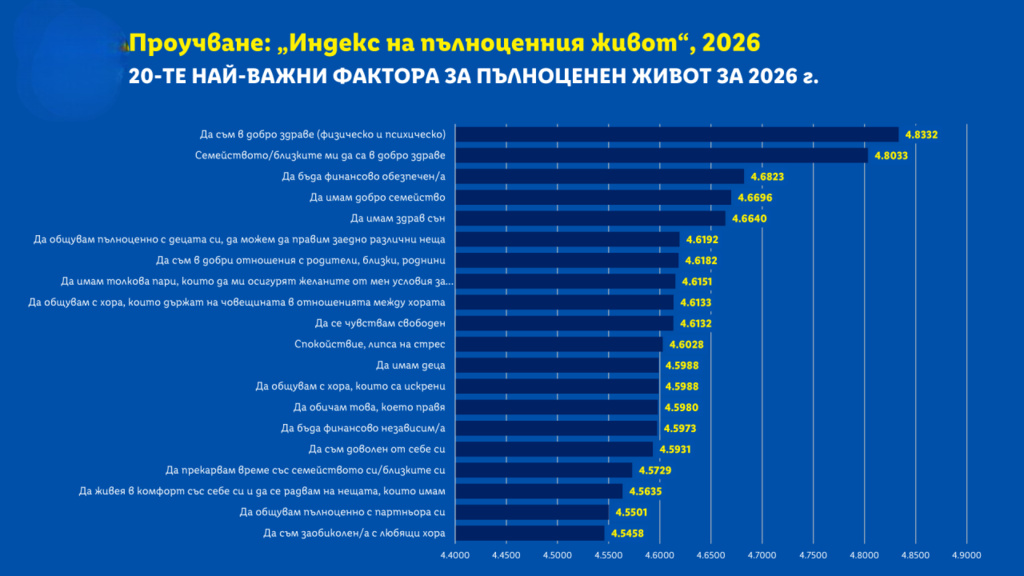
PHOTO Progress Consult
The index is calculated on the basis of 82 specific factors grouped into seven areas: health, finances, family and relationships, personal goals, career, education and leisure. It compares the importance of each factor to people with the extent to which it is actually present in their lives.
The main finding this year is that health and financial well-being are the most important concerns for Bulgarians. Personal health ranks first in importance among respondents, followed by the health of their loved ones. Financial security has recorded the largest increase, rising from eighth place in 2022 to third place in 2026.
For the first time, personal freedom and autonomy have entered the top ten most important values, rising from 18th to 10th place in terms of importance to Bulgarians.
According to the author of the study, sociologist Dr Rosen Kutelov, data from the past four years show that Bulgarians have moved “from a state of acute anxiety to an adapted state of insecurity”. In his words, people are responding by narrowing their social circles, focusing on those closest to them and creating a protected personal world, with a practical approach and higher expectations for their own well-being. The survey provides supporting evidence: in 2022, 33.8% considered the broader social environment extremely important, while in 2026 the figure fell to 29.6%.
According to Kutelov, the greatest discrepancy in the lives of Bulgarians is between their desire for financial security and the extent to which they actually achieve it.
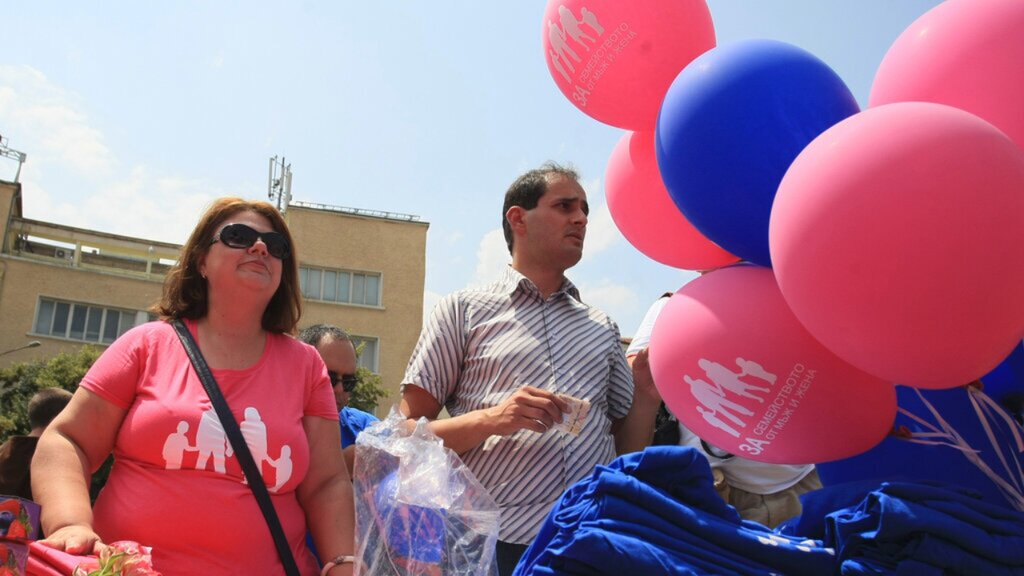
PHOTO BGNES
Peace, family and security are the most important values according to the results of the second-largest national survey, conducted among 1,003 adults on the subject “The Values That Connect Us”. It was carried out in early 2023 by Trend polling agency at the request of communications agency Interpartners Group.
In the survey, 46% of respondents identify peace as the leading value. In earlier similar studies, family had ranked first, but against the backdrop of the war in Ukraine, peace moved to the top in 2023. Family ranks second in importance at 37%, followed by security at 36%.
For the youngest respondents, the most important values are peace, freedom and human rights. The study reveals an interesting comparison between security and freedom, with the results clearly showing the preference in Bulgarian society: if forced to choose, 52% of respondents place security above freedom. People aged 18 to 39, predominantly men, however, are more likely to favour freedom. The findings are, of course, a reflection of the ongoing war in Ukraine and the emerging new conflicts in the Middle East.
Considerably further down the list in the 2023 analysis of 14 values are freedom of expression (14%), democracy (13%), tolerance (11%) and equality (9%). Gender equality comes last, at 4%, although in practice Bulgarians express strong support for it. As many as 83% categorically reject the statement that women should be subordinate to men, 77% believe household chores should be shared, and 70% do not accept that men should earn higher salaries than women.
Children stand out as a key value for couples in Bulgaria, while marriage as an institution is losing significance in contemporary Bulgaria, with 55% saying that getting married is not necessary.
PHOTO Pixabay
As regards a sense of belonging to a larger group of people, the largest share of participants, 53%, say that for them this is Bulgaria, while 22% identify with their local community and only 6% with the European Union. The authors believe this indicates a continuing distance from the EU following Bulgaria’s accession to the bloc in 2007.
As for education, historically an important value for Bulgarians, Trend’s findings show that 90% of respondents believe education and healthcare should be completely free, while 81% think the state is obliged to provide a job for anyone who wants to work. The sociologists reject the easy explanation that this is simply a legacy of the past, noting that the figures among the youngest respondents are almost identical to those for society as a whole.
In this context, 62% believe that success in Bulgaria depends on whom you know. The same view is held by 56% of the youngest respondents and 61% of those with higher education. The majority do not believe that a person in Bulgaria can succeed through hard work or become wealthy through honest means.
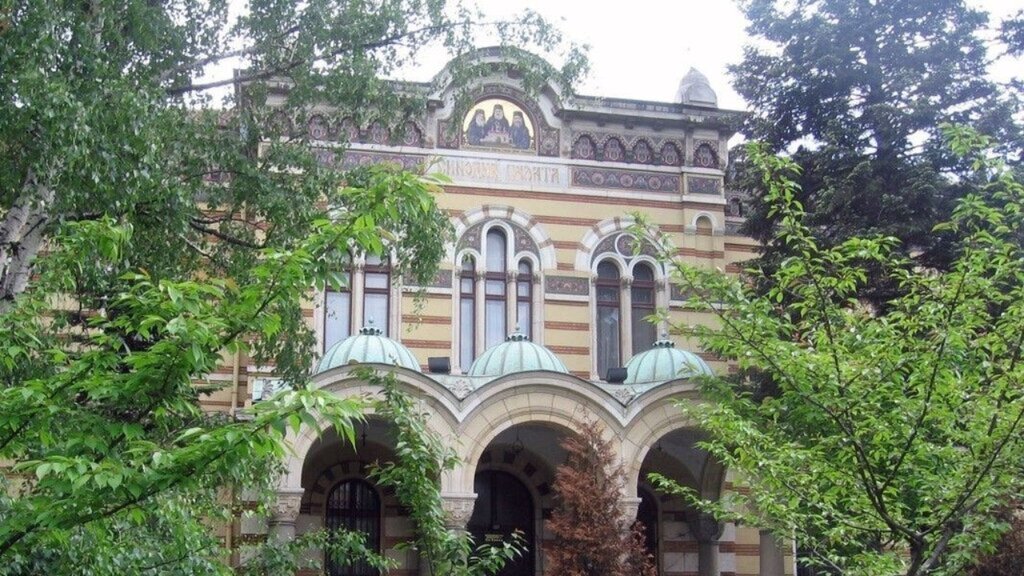
The Holy Synod of the Bulgarian Orthodox Church
PHOTO patriarshia.bg
As regards values related to faith and religion, Bulgaria displays institutional trust without deep religiosity. This conclusion can be drawn from data by Gallup International Balkan from a survey conducted for the Bulgarian National Television between 28 March and 5 April 2024 among 805 people, through face-to-face tablet-assisted interviews, using a representative sample of the adult population. Sociologists note that trust in the Church has remained stable in recent years, ranging between 40% and 50%. Some 49.7% of respondents say they trust the Church, while 34.1% take the opposite view.
A separate survey by the same agency in August 2024 shows that trust in the Church stood at 43.1%, compared with 35.8% expressing distrust, and adds an important detail: three quarters of people identify as Orthodox Christians, but just under two thirds say they believe in God. Trust among the youngest respondents is low.
The international picture is similar: according to a 2022 global survey by the World Association of Gallup International, 53% of Bulgarians describe themselves as religious, placing Bulgaria among the moderately religious societies worldwide.
PHOTO BTA
The moral compass of young people: human rights, security and anxiety
A detailed portrait of young Bulgarians can be found in the findings of the Friedrich Ebert Foundation’s 2024 study “Optimism about the Individual, Pessimism about Society”, conducted in partnership with the Ivan Hadzhiyski Institute of Sociology. The study covers young people aged 14 to 29 in 12 countries in Southeast Europe.
When asked which values related to democracy are most important to them personally, Bulgarians under the age of 29 rank human rights first (24%), followed by security (20%) and economic well-being (14%). Equality (7%) and democracy (5%) remain at the bottom of the list. The idea of emigration is not unfamiliar to 74% of those surveyed.
A secondary analysis of the same data also reveals a gender difference: young women seek protection through solidarity and rights, while young men place greater emphasis on strength, order and economic pragmatism.
The researchers note an overall high level of anxiety among Bulgaria’s active population. According to Associate Professor Boris Popivanov, one of the authors of the study, young people’s fears are primarily existential, concerning life, health and the future. They are most often worried about the healthcare system (47%), war (44%) and climate change (42%).
Another trend highlighted by the findings is increased civic and political engagement among young Bulgarians: 21% say they are interested in the country’s political life, compared with just 7% in the same study in 2018.
PHOTO European Parliament
Where do we stand against the backdrop of Europe?
According to a large-scale Eurobarometer survey conducted in February-March 2025 on the values that the European Parliament should defend, Bulgarians put peace first (45%), followed by democracy (32%) and the protection of human rights (22%).
A Eurobarometer survey conducted at the end of 2021 found that 25% of Bulgarians wanted European institutions to protect respect for national identities, cultures and traditions, compared with an EU average of 14%. Gender equality was considered important by only 11% of Bulgarians, compared with 24% across the EU.
As many as 48% of Bulgarians believe that their voice is not taken into account in the European institutions.

PHOTO magnific.com
In conclusion, we can say that at the top of the moral pyramid of contemporary Bulgarians stand their families and loved ones. The succession of political crises and financial instability, inflation and armed conflicts in recent years has turned the desire for peace, security and financial stability into a leading aspiration for Bulgarians. Security is placed above freedom, particularly among older people, while trust in institutions remains low. Most troublingly, democratic principles and equality among people continue to lose ground in the personal value systems of Bulgarians today. This can only raise further questions about the nation’s bright European future.
Editors: Vesela Krasteva, D. Semkovska
This publication was created by: Rositsa Petkova