News
Every tenth Bulgarian woman is diagnosed with breast cancer, which is increasingly affecting younger women, says Prof. Svilеn Maslyankov
Bulgarian medical invention helps in cancer surgery
The inventors are a team of engineers from the town of Gorna Oryahovitsa
Saturday 10 October 2026 14:25
Saturday, 10 October 2026, 14:25
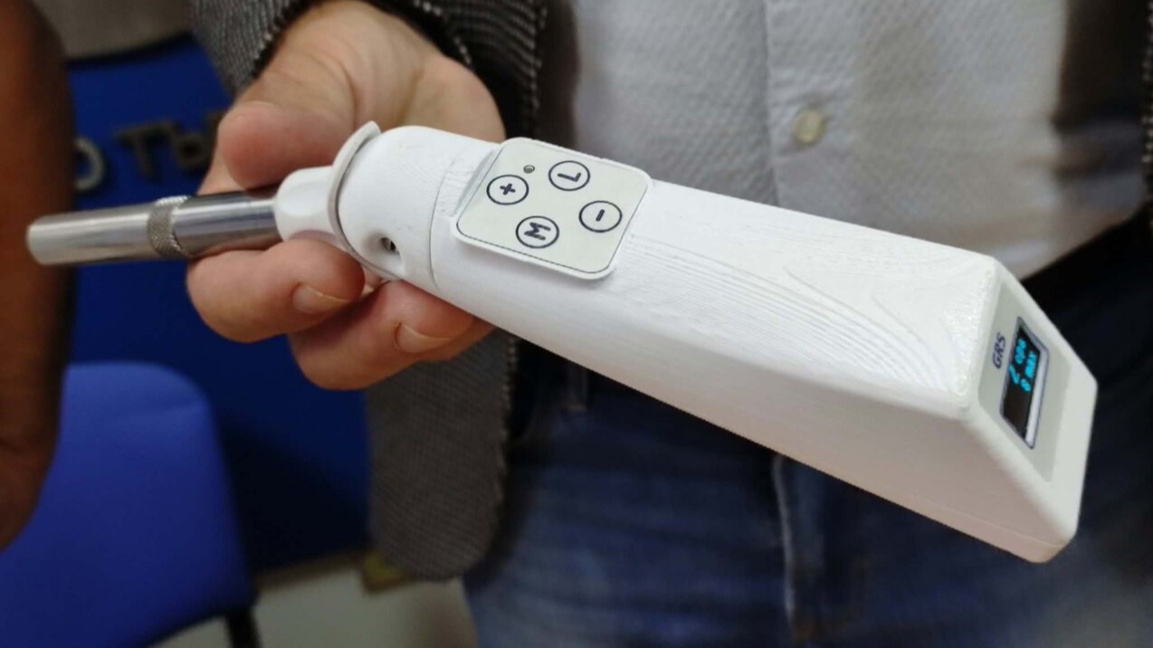
PHOTO Zdravka Maslyankova
Font size
A team of engineers from the town of Gorna Oryahovitsa in northern Bulgaria has invented the first portable gamma spectrometer detector in Bulgaria to be used in oncology, particularly in breast cancer surgery.
“Every tenth Bulgarian woman is diagnosed with this serious disease, which is increasingly affecting younger women,” said Professor Svilеn Maslyankov, an oncological surgeon at Sofia's Alexandrovska Hospital. He has already operated on four women with breast carcinoma using a prototype of the medical invention.
“The use of this device in cancer surgery helps preserve patients’ quality of life and prevents postoperative complications,” Professor Maslyankov said.
The inventors from Gorna Oryahovitsa spent a year and a half developing the portable gamma spectrometer, working in consultation with a nuclear physicist and oncologist Professor Svilеn Maslyankov. There are international equivalents of the device, but according to its inventors, the Bulgarian version is more sensitive and accurate in cancer diagnosis.
“The purpose of the device is to detect tumour cells and, at the surgeon’s discretion, remove the affected soft tissue. Thanks to the sensor we developed, our device has greater sensitivity than the equivalent device against which Professor Maslyankov compared it in clinical conditions,” explained the inventor, engineer Mihail Chenkov.
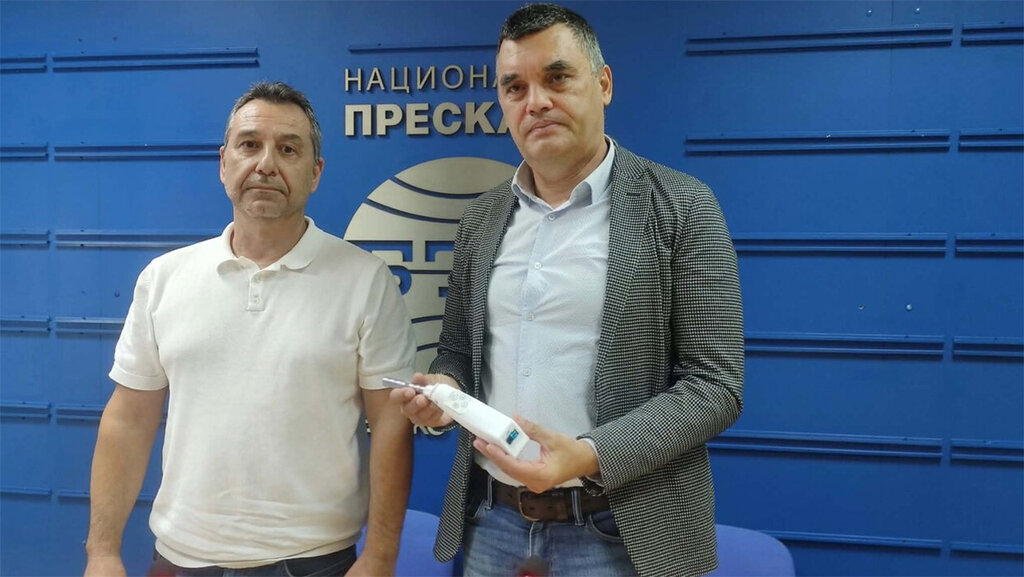
Mihail Chenkov (left) and oncology professor Dr. Svilen Maslyankov
PHOTO Zdravka Maslyankova
The gamma spectrometer has a built-in temperature sensor, which is of great importance to surgeons:
“This temperature sensor provides information, and every 100 milliseconds the device automatically adjusts itself. A change of just one degree in the ambient temperature produces a 3% measurement error. Another innovation is the articulated arm, which bends at an angle of around 30 degrees. This allows the surgeon to access more difficult-to-reach areas in order to carry out the diagnostic procedure.”
The device is used for so-called sentinel lymph node mapping in breast cancer and other types of cancer.
“The day before surgery, a radionuclide is injected into the breast area where the tumour is suspected to be located. Its molecules accumulate in what is known as the sentinel lymph node. If there is no cancerous spread, only this lymph node is removed, rather than the entire lymphatic bundle, as is currently done. The precision of the procedure eliminates subsequent complications and significantly improves patients’ quality of life,” Professor Maslyankov explained.
“Breast cancer prevention in Bulgaria faces serious problems,” Professor Svilеn Maslyankov said:
“Some 6-8% of breast cancer cases are genetically determined. There are no programmes to identify and prevent them. There is no established screening programme. Mammography is performed after the age of 45 and is voluntary. A screening programme requires resources, but it would mean that patients could be diagnosed at a much earlier stage.”
Breast cancer is increasingly affecting younger women. Professor Maslyankov said that last year he diagnosed a 23-year-old woman with the disease, while several months ago he operated on a 28-year-old woman with breast carcinoma.
The invention developed by the engineers from Gorna Oryahovitsa, a portable gamma spectrometer that can assist in cancer surgery for breast cancer, melanomas and various other oncological diseases, is now awaiting certification. The process is expected to take at least a year before the device can be placed on the market. Its development was supported by a grant under the EU Operational Programme “Competitiveness”.
Editor: D. Semkovska
English: R. Petkova
This publication was created by: Rositsa Petkova