


Interview
Vera Politkovskaya: Do not trust anyone and always check everything!
Thursday 22 October 2026 09:34
Thursday, 22 October 2026, 09:34
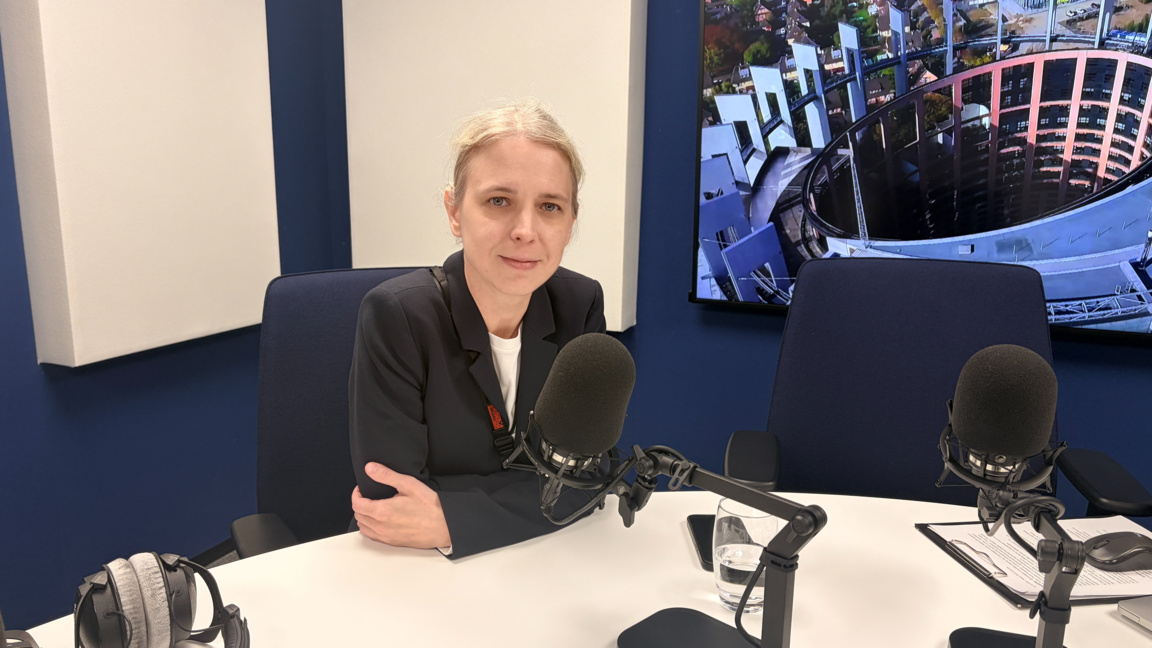
Vera Politkovskaya in Radio Studio 3 at the European Parliament in Strasbourg
PHOTO Rositsa Petkova, BNR
Font size
Vera Politkovskaya is at the European Parliament in Strasbourg for a seminar dedicated to the presentation of the Daphne Caruana Galizia Prize for Journalism.
We are meeting at a time when it is 20 years since the murder of your mother, Russian journalist Anna Politkovskaya. You are the daughter of a journalist who became a symbol of resistance to authoritarianism and Vladimir Putin’s rule. But you are also a daughter who lost her mother. Your mother wrote about Chechnya, state violence and the concentration of power. Which of her warnings do we understand most clearly today, following Russia’s full-scale invasion of Ukraine?
"Of course, I think the most important thing is what she saw in Vladimir Putin right from the beginning, when he had only just taken office as president. She spoke and wrote a great deal at the time about how he had a background in the KGB and how, as the saying goes, there is no such thing as a former KGB officer. She understood that he was ruthless enough to go all the way.
Many people used to say, “Oh, Anna, you have such a dark view of reality. You see everything in such gloomy colours.” These arguments took place around the family dinner table, as well as outside the family, among friends and fellow journalists.
That is why I believe this was the most important thing: even back then, so many years ago, more than 20 years ago, she recognised in Putin the man that nobody else was able to see at the time."
Six people were convicted of involvement in your mother’s murder, but the person who ordered it was never identified. The European Court of Human Rights ruled that the investigation had been ineffective. What does it mean for your family to know that the perpetrators have been convicted, but the full truth has never come to light?
"For us as a family, and for me personally, it means just one thing: the crime has not been solved. And the most important thing is to identify the person who ordered the murder.
Objectively speaking, I understand that we will not learn the truth until the current authorities and the system in Russia are gone, collapse or are transformed in some way. I am absolutely convinced that the person who ordered the murder is being protected by someone, which is why we still do not know their name. I am talking specifically about the people who govern Russia today."
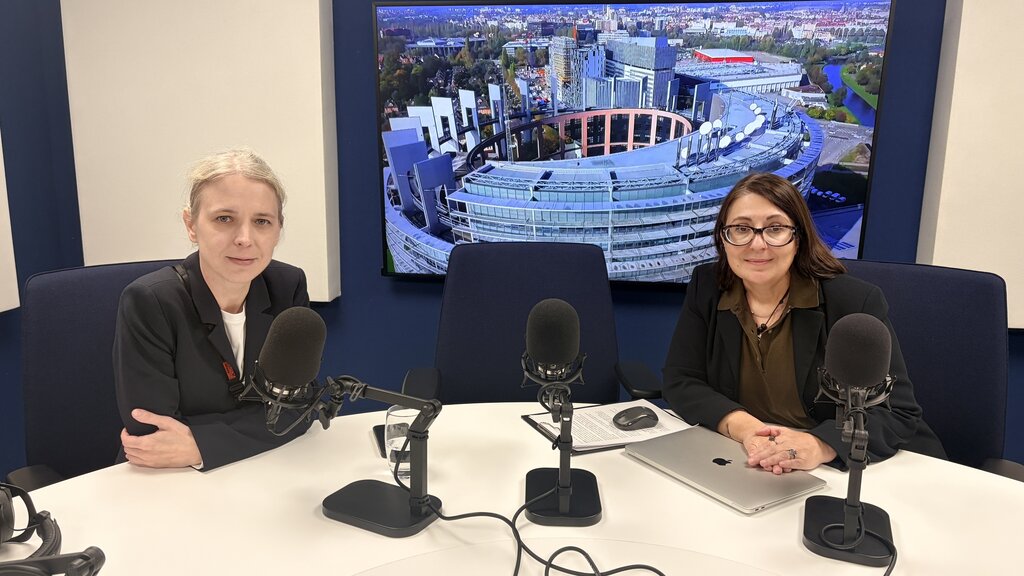
Vera Politkovsakya with BNR journalist Irina Nedeva
PHOTO Rositsa Petkova, BNR
Do you have doubts about whether the person who ordered the murder might not be part of the country's highest leadership, but someone else?
"You mean, could the person who ordered it be someone outside the political elite? You know, in theory, that is possible. But in Russia, business and politics go hand in hand. So I think that, either way, this person holds a senior position.
You know, there are journalists who investigate all kinds of cases involving financial and business matters. But my mother was a person of firm principles, and she stood by those principles. I think the murder was ordered for precisely that reason, not because someone owed someone money or something like that. No, not at all. It was all about the truth she defended and the way she did her work. That is exactly why she was killed."
It was like a birthday present.
"To be honest, I did not know that Vladimir Putin’s birthday was on 7 October. On the day my mother was murdered, I learned that it was Vladimir Putin’s birthday."
And how does his daughter live with this? Do you feel threatened, given that he is such an influential person?
"You mean the threat..."
The threat to your personal safety.
"You know, we live in a time when nobody who comes from Russia can be completely sure they are safe, wherever they may be, whether in Europe or in Russia. As far as Russia is concerned, it is clear: people with opposition views who live there can effectively be regarded as hostages of the system."
If your mother were alive today, where would she be: in Russia, in prison, or at the scene of events in Ukraine? And what would she investigate first today?
"Today, she would be focusing on ordinary people caught in the crossfire of war, crushed by its merciless machinery, if I may put it that way. She would be looking at how people there live, people who are simply going about their lives and have nothing to do with politics. Ordinary people in villages, small settlements and towns... I am convinced that she would be among them, gathering information, provided, of course, that she was allowed to do so. Because we understand that no journalist can reach a place they are not permitted to enter.
Ultimately, I think that today she would either have been murdered too or would be in prison."
There are people in Russia who continue to oppose the war and authoritarian rule, but the price they pay is high. What do you think Europeans often fail to understand about Russian society today and the personal responsibility of citizens living under a repressive system?
"You know, it seems to me that Europe does not fully understand how this repressive system works, particularly within Russia itself.
Right from the beginning, when the war started in February 2022, there were calls for the Russian population to find some way of dealing with the situation themselves. But if we look at things objectively, over the past few years... In fact, not just the past few years, but over at least the last decade, the laws in Russia have become progressively stricter. This is especially true of laws targeting people who express views that differ from what everyone hears on television."
A person can even be arrested for holding up a blank sheet of paper?
"Yes, even for holding up a blank sheet of paper. I could stand there with a blank sheet in my hand and be arrested for it. Today, you can be sent to prison for practically anything, you see?
There are so many laws in force there now which, excuse the blunt expression, are designed to silence anyone who says anything that differs from the prevailing mainstream narrative. Under these circumstances, that is entirely possible. Everything has been designed to make people keep quiet and do nothing.
And just look at the number of court cases in which people receive lengthy prison sentences. Sometimes it seems as though these trials are being conducted to intimidate everyone else."
Is there anything Europe can do to help Ukraine and defeat Putin?
"You know, it seems to me that European politicians relied for a long time on attempts to reach agreements through talks, on diplomacy. Yes, diplomacy, which, let’s be honest, had already failed before 2022. Diplomacy failed completely, and that is precisely why the war happened.
But now, if we take a broad view of everything that has happened since February 2022, putting it rather bluntly, the most important thing is not to believe a single word. Not the words of the president, not those of the people around him, and not, in principle, the words of politicians in general. Because this has become a rather curious game, hasn’t it? It is clear why European politicians do what they do and what they are trying to achieve. But on the other side... You know, we can go on playing this game of words for a long time."
If you had to choose one message you would like MEPs to remember from your speech tomorrow, what would it be? What, specifically, do you expect from Europe?
"The main point, perhaps, is that I will be speaking on behalf of Russians living in Europe today, including journalists who found themselves in Europe after the war began.
I would like them to be allowed to do their work without obstruction, because they really can achieve a great deal. Despite all the bans, blocks and similar restrictions, people in Russia continue to read their work and are gradually learning things that propaganda and the state-controlled media largely conceal from them. In practice, only these media outlets remain: either those that support the current authorities or those that are simply state-run. Journalists must be allowed to do their work without obstruction."
Vera, you know that there are people in Bulgaria who believe Moscow. What would you like to say to them?
"I understand your question. Do not be naive, do not trust anyone, and check everything several times. That is all I can say."
Thank you very much.
This publication was created by: Rositsa Petkova