


Author
Tsvetana Toncheva
Article
Conductor and violinist Droujelub Yanakiew: Being Bulgarian is profound
One of the most active and creative Bulgarian musicians in Switzerland is among the four recipients of the 2026 Music Awards of the Canton of Bern.
Monday 16 November 2026 20:00
Monday, 16 November 2026, 20:00
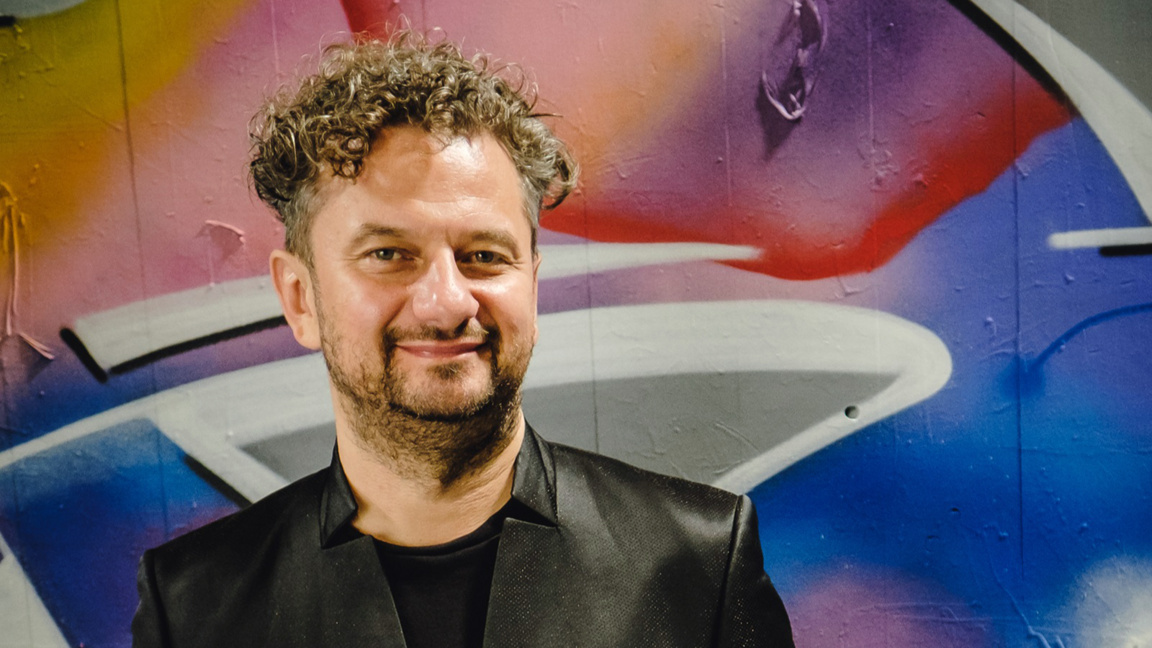
Droujelyub Yanakiew
PHOTO droujelubyanakiew.com
Font size
A talented Bulgarian with the rare name Droujelub has received a prestigious award for his contribution to the cultural life of Bern. The Music Awards of the Canton of Bern will be officially presented on 17 November 2026 at the Nebia Theatre in Biel/Bienne. Worth CHF 15,000, the awards are granted on the recommendation of the cantonal music commission and recognise professionals who have made a significant contribution to the region’s musical life. The distinctions also include a “Coup de cœur” award, the jury’s choice of outstanding young talent, as well as five film awards.
Droujelub Yanakiew is a conductor and violinist known across Europe for his innovative projects, which bring together different musical styles and generations. The 2026 award recognises his work in enriching the Swiss music scene by combining classical music with popular contemporary genres and other art forms.
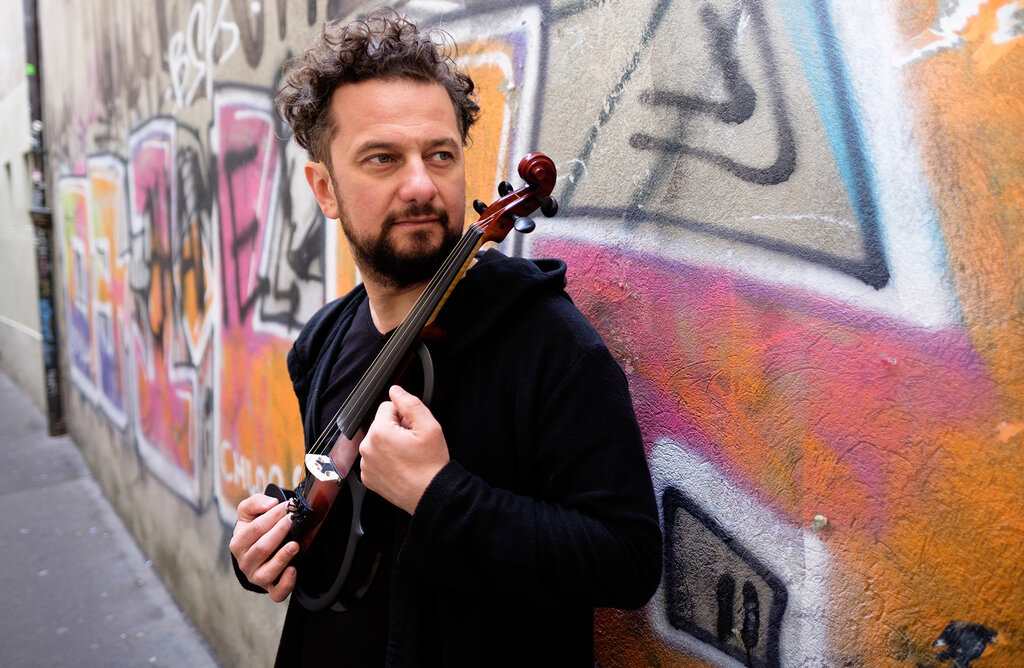
PHOTO droujelubyanakiew.com
Droujelub was born in Sofia into a family of musicians. After graduating from the Sofia’s music school, he was admitted to the National Academy of Music to study violin. He was then offered the opportunity to continue his studies in Switzerland and moved to Bern in the mid-1990s. He graduated from the University of Music and Theatre in Bern with two violin diplomas, in concert performance and solo performance, and went on to graduate with distinction as a symphony and opera conductor from the Zurich University of the Arts.
Yanakiew conducts mainly in Switzerland and Germany and has worked with leading symphony and chamber ensembles from Bern, Basel, Zurich and Geneva. As a violinist, he has appeared as a soloist with the Sofia Philharmonic, almost all Bulgarian orchestras, and ensembles in Switzerland and Argentina. With the prestigious Festival Strings Lucerne, he has performed on several continents alongside some of the world’s leading soloists, including Mischa Maisky, Daniil Trifonov, Hélène Grimaud and Rudolf Buchbinder.
Since 2008, he has been conductor and chief artistic director of the Variaton Projektorchester symphony orchestra in Bern. He has worked with leading Swiss jazz and rock musicians, as well as with Theodosii Spassov, the “kaval player of the world”. A distinctive feature of Droujelub Yanakiew’s performances is that he combines the roles of conductor and violinist on stage. The creation of new and unconventional musical ideas is a defining thread running through his artistic career.
In a special interview with Radio Bulgaria, Droujelub gives a detailed account of his work. Of the four orchestras he leads, the most important to him is the Variaton Projektorchester in Bern, a large symphony ensemble whose members include professional musicians, students and highly accomplished amateurs. The project was established to experiment with new formats and ways of presenting and combining classical music.
“Each project is a kind of combination of different art forms and different musical styles. We work with absolutely every art form imaginable. Our most recent project involved lighting design and projections. Before that, we performed Richard Strauss’s Ein Heldenleben together with an artist. Since this is a symphonic poem consisting of six different scenes, the artist painted pictures live during the concerts to accompany the different sections, and these were projected onto the walls of the concert hall, alongside dance.
“We also work a great deal with texts. What is known as Poetry Slam is popular in Switzerland. I don’t know whether it exists in Bulgaria, but here it is a form of poetry, a play with language and words, often involving improvisation. So, generally speaking, I love mixing things. I enjoy many different art forms and I like bringing them together and experimenting. Sometimes I feel like a chef looking for new dishes.”
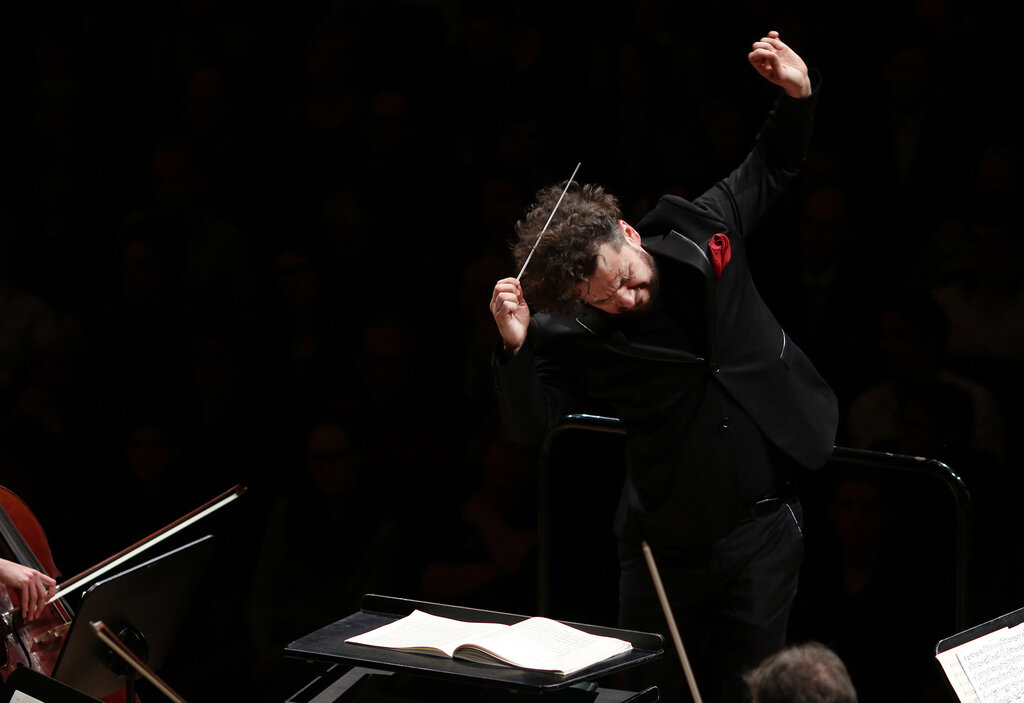
PHOTO droujelubyanakiew.com
Some of Droujelub’s ventures may seem rather eccentric, such as combining a rock band with Mahler’s symphonies. Yet he insists that this is not the effect he is seeking:
“Being eccentric is not my aim at all. I don’t do these things to attract attention or to show that I am different. I am simply interested in the mixture itself. Some projects are very intimate, and eccentricity has nothing to do with them. The point is to create a particular atmosphere... What happens is that when we bring these art forms together, the audience also becomes a mixture of people...
Our next project is Stravinsky’s The Rite of Spring, which we are combining with a progressive metal band... As for the rock band performing with Mahler, I am always looking for parallels, for something that connects the two. Even when a chef combines unconventional ingredients, there still has to be something that brings the flavours together. This rock band is very interesting. It was formed around some very old Swiss folk songs. Swiss and Austrian folk music sound quite similar, while Mahler’s music contains many borrowings from folk songs. The band, Kummerbuben, began its journey by searching for old folk songs and reinterpreting them with a more modern, rock-oriented sound. I found some very interesting parallels in the musical DNA of this band and in Mahler’s music.”
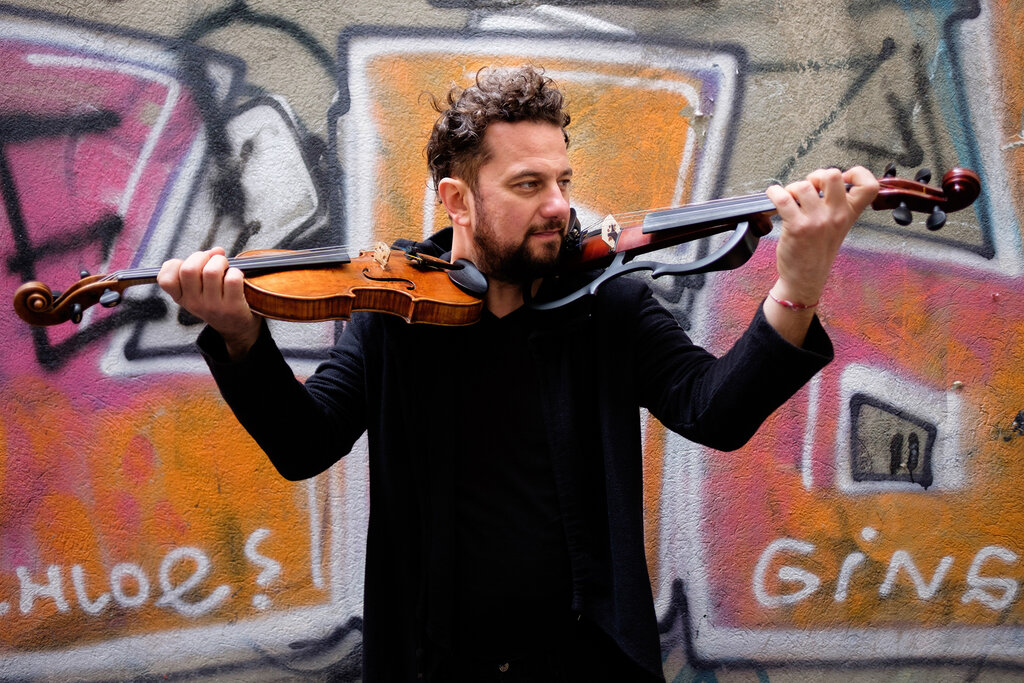
PHOTO droujelubyanakiew.com
Droujelub also speaks enthusiastically about the Swiss progressive band with which he is preparing Stravinsky’s The Rite of Spring, Sonorous Dynamo:
“The heart of the band, its guitarist and vocalist, is actually one of the finest cellists in Switzerland. He teaches at the Bern Conservatory. He is a classical musician who loves heavy metal and progressive metal. We are talking about very complex music, with intricate rhythms and arrangements, and that is where I find a connection with Stravinsky... In fact, at the beginning of the 20th century, Stravinsky was a ‘progressive classical composer’.”
Droujelub also reflects on improvisation, an inevitable part of projects such as his:
“For me, the best improvisation is one that has been very thoroughly prepared. But at the sublime moment when a person improvises, they open themselves up and leave room for something to happen spontaneously.”
He then recalls an unforgettable experience on stage with Theodosii Spassov and shares his thoughts:
“The moment when we are on stage and the audience is there is somehow unique... It is different every time. It depends on us, but also on the audience present that evening. These are people and energies that you can sense, and they inspire other ideas and other states of mind... The moment of stepping onto the stage is always the same, yet it is also different. That is something I seek in my projects: improvisation that has been carefully thought through, while still leaving space for something to happen just once and then pass.”
Аmong the most important mentors in his life, Yanakiew singles out his violin teacher, the distinguished Bulgarian musician Yosif Radionov, a renowned educator and long-serving concertmaster of the Sofia Philharmonic. Radionov took him into his class while he was still at music school, and continued teaching him at the Academy in Sofia.
“He was not only a teacher, but a person who shaped me as both a musician and a human being. Another very important mentor for me was Ventsislav Nikolov, a cellist, chamber musician and conductor. In fact, it was thanks to him that I was able to come to Switzerland.”
Alongside these two eminent Bulgarian musicians who taught him, Yanakiew also speaks about Johannes Schlaefli, who has taught Deliana Lazarova, currently the most successful Bulgarian woman on the international conducting stage:
“Johannes Schlaefli is the teacher of many people who are now enjoying extraordinary careers. Today he is one of the most respected conducting professors in the world. He teaches in Europe and America and often comes to Bulgaria to give conducting masterclasses. He is one of the most important teachers in my life, because I studied with him for eight years. For a violinist, making the transition to conducting is actually very difficult, and he helped me enormously, with great patience...”
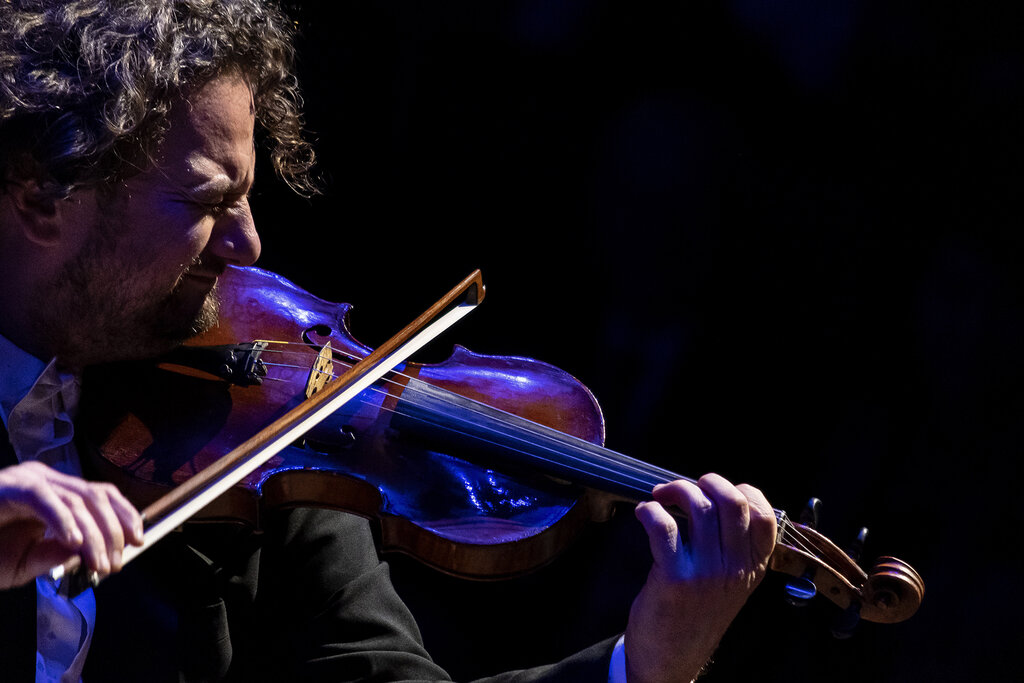
PHOTO droujelubyanakiew.com
Is it difficult for a Bulgarian to live and work in Switzerland?
“When I arrived in Switzerland, the political situation was very different. Bulgaria was not yet part of the European Community, and the problems were mainly organisational and administrative, but those can be resolved. I can say that, particularly in Switzerland, being from Bulgaria has helped me greatly as a musician. Back then, people would say: ‘Oh dear, Bulgarians in Europe! Guest workers, thieves... criminals!’ There was nothing like that in Switzerland. I think those guest workers were more likely to be in Germany and Austria. So I have hardly ever had a negative experience in Switzerland.
The Swiss know what they are good at: they make watches, banks and chocolate. They excel at everything involving exact sciences, discipline and quality. But they do not really see themselves as a nation that has given much to the arts... I remember when I first came to Switzerland, people would say: ‘Oh, he’s Bulgarian. Well, that’s where the musicians come from!’” There was a time when many musicians from Eastern Europe moved to the West. We had a very good system of education, and everyone was trained to a very high standard. In fact, I can say that being Bulgarian helped me greatly as a musician in Switzerland, because I was different, I brought a different energy. Being different is an advantage for a musician...
We had rigorous training: our instrumental tradition, our music schools, our entire theoretical education. That was something from the past that was very good. I don’t know how things are now or whether they have managed to preserve it, but when I look at all my former classmates and friends, I see that they are now all over Europe and around the world. Some of the best orchestras have Bulgarian concertmasters and soloists in leading positions... This is something we should be aware of, and it is something that is appreciated here.
Of course, there are a number of things you have to learn simply to survive in this environment. I had to learn discipline, punctuality and order above all. But in the end, I put in the effort. I had to adapt in some way, because life in Switzerland and life in Bulgaria are very different. At least they were. Now I have the feeling that Bulgaria, too, is gradually beginning to change. But when I first arrived here, they were like two different planets. At first, I felt like a Martian...”
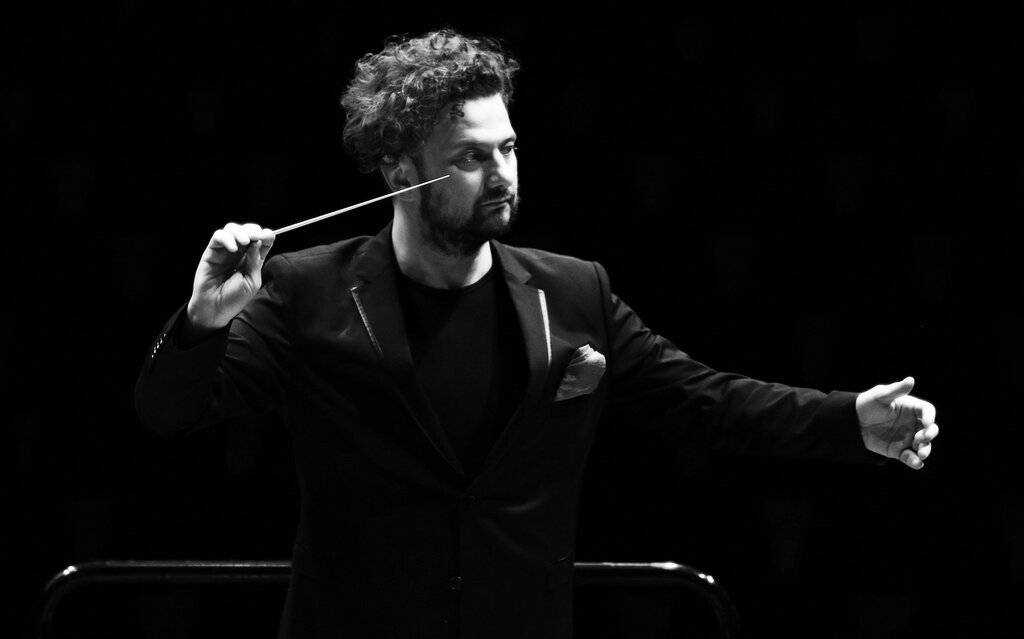
PHOTO droujelubyanakiew.com
We also discuss Droujelub’s rare and rather striking name, which he disliked intensely as a child but has come to appreciate. He says that whenever he introduces himself to foreigners, the name works “like an accent, a sforzato”, and the initial reaction is quite a shock:
“I say it again: Droujelub. They tend to distort it a little, but the interesting thing is that somehow the name sticks. It stands out, and people seem to like it, because I have sometimes met people I hadn’t seen for 15 or 20 years, and they say: ‘Hey, Droujelub!’ So they remember the name... I can say that, as a musician, my name actually serves me very well, because once someone has learnt it, they remember it. I don’t need a stage name.”
Finally, we ask the musician with the beautiful and welcoming name whether he has a friendly wish to share with Bulgarians, both at home and around the world.
“There are different subjects that interest a person. At the moment, from a purely musical point of view, I am very interested in the Middle Ages. I read a lot, listen to medieval music and learn about society, its development and politics in that period. And I am beginning to realise just how long we Bulgarians have been around. When you see how many different empires have fought one another... we have somehow been here for a very long time, and we are still here, despite all the hardships and difficulties throughout our history. I feel there is something in being Bulgarian. But I don’t mean Bulgarian identity in the sense of pride, of saying ‘I am proud to be Bulgarian’. For me, it is more about that spiritual dimension...”
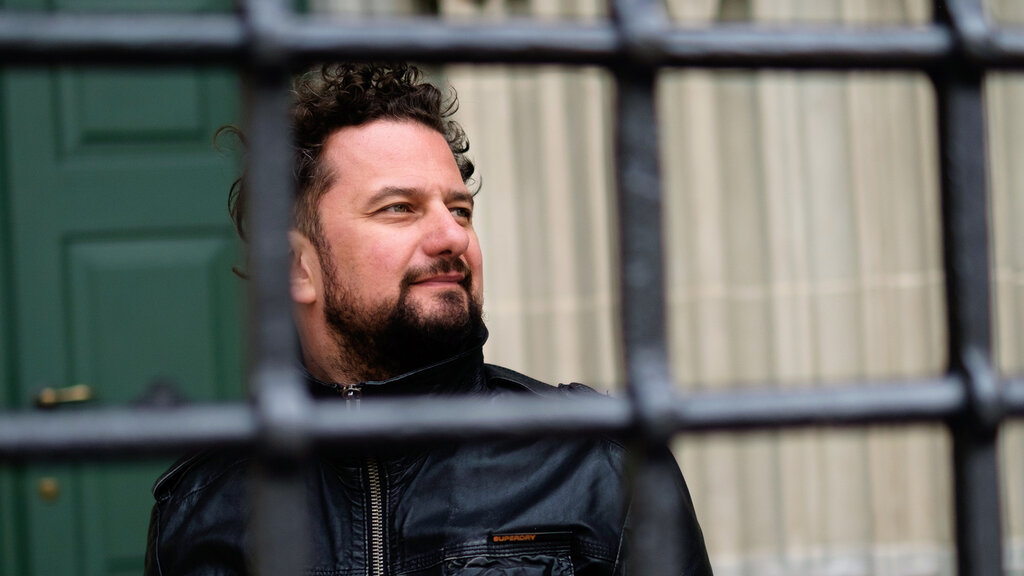
PHOTO droujelubyanakiew.com
“What I can say from my encounters with Bulgarians around the world is that, at a certain point, you sense a spiritual depth. Whether we like it or not, we carry thousands of years of history within us. But I don’t think this is any reason to be proud. It is rather something to be happy and content about. It is enough simply to recognise it, to be aware of it, and not to make a show of it.
Nowadays, I see many people using Bulgarian identity for various other purposes. That is not the kind of Bulgarian identity I consider genuine. The true essence of being Bulgarian is quiet and profound. If we can feel it and turn towards it, without making a display of it, but simply knowing it is there and being happy to be Bulgarian, that is enough. And we should remember that many other people, too, have wonderful qualities.
I don’t like pride! Pride tends to elbow its way forward. Perhaps that is something I learnt in Switzerland: to accept yourself, respect yourself and simply be happy to be who you are. That is already a great deal. And, of course, above all, we should take care of the spirit. The body comes and goes. The spirit is something that endures. And while we are alive, we have the opportunity to make use of it and take joy in it...”
This publication was created by: Rositsa Petkova