Author
Diana Tsankova
News
Early parliamentary elections - 19 April 2026
Chavdar Vlachkov, Belgium: Parties have no interest in new early elections
Sunday 19 April 2026 17:46
Sunday, 19 April 2026, 17:46

PHOTO chavdarvlachkov.eu
Font size
The election campaign, created with the mission of inspiring voters to fulfil their civic duty and guiding those who are undecided in making their final choice, once again left behind uncertainty, ambiguity, and a sense of deadlock. As a result, it is expected that mainly those who consistently vote for the same parties and politicians, as well as those influenced by specific information channels, will once again go to the polling stations.
“Unfortunately, instead of voters receiving a multi-layered campaign, they were given a bit of everything or a lot of nothing, and in the end the substance was lost,” says Bulgarian Chavdar Vlachkov, who lives in Brussels. He is a representative of the National Development Network and an active participant in the national campaign Dai Glas (“Give Your Vote”). According to him, citizens cannot make an informed choice based on campaign messages that feel vague, lacking substance, and almost as if written by artificial intelligence.
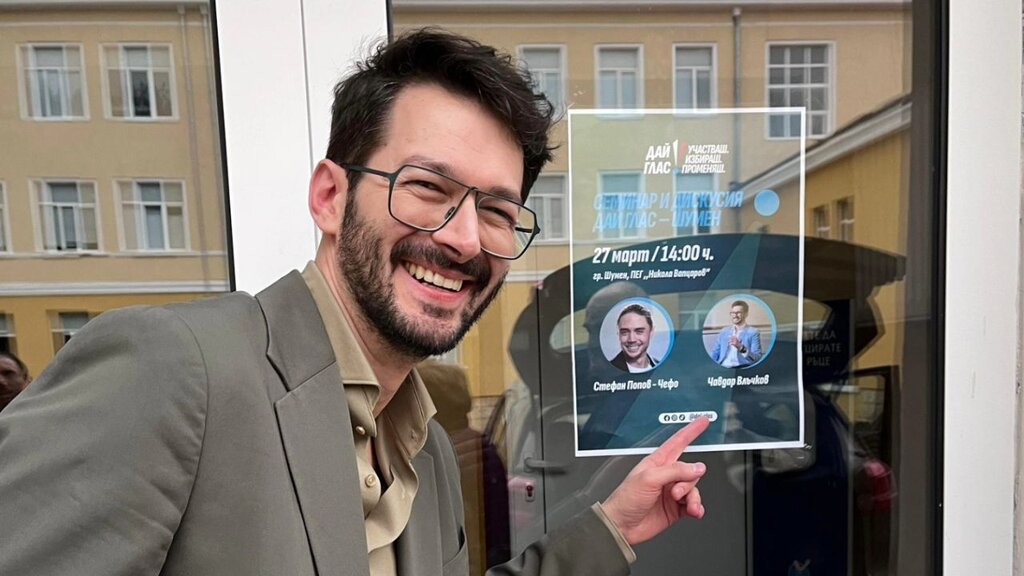
PHOTO Facebook /Chavdar Vlachkov
“Many major leaders did not step forward, while others were overly present,” the activist says. “Instead of relying on substance, some parties focused on personalities, competing over who would generate more viral content, attract people, or provoke them. Nationally, we see a huge contrast in political culture and an avoidance of responsibility. In smaller towns, however, the distance between candidates and voters - which should be close in such communities - sometimes doesn’t exist at all. The cases of so-called ‘parachuted’ candidates and list leaders are an additional problem in this eclectic mix we were presented with.”
Recently, Hungary offered a lesson in civic responsibility with high voter turnout. In Bulgaria, even with an increase of 200–300 thousand votes, turnout is not expected to come close. Why do citizens remain passive in a country that often ranks poorly within the European Union?

PHOTO Facebook /Chavdar Vlachkov
“We are not pushed to the brink of survival, including geopolitically, as Hungary was - and that motivates people there,” Vlachkov explains. “Unfortunately, corruption has always existed here - sometimes more visible, sometimes less - which angers people because in a rule-of-law state it should not go unpunished. That’s why I ask politicians: why do they expect higher turnout when they offer no real alternatives?”
Vlachkov is convinced that people care and are engaged, but struggle to find effective tools to create change. “It is the politicians’ responsibility to provide those tools, even if they may be used against them,” he adds.

PHOTO Facebook /Chavdar Vlachkov
Having lived abroad for many years, he observes that Bulgarians everywhere - including those in Belgium - want the same thing: a functioning rule-of-law state. Another shared trait is frustration with the low level of political discourse. “Political rhetoric has hit rock bottom in recent years - largely reflecting the media and digital environment - and this is a major demotivator,” he notes.
Whatever the outcome of the elections, Vlachkov does not expect Bulgaria’s Euro-Atlantic orientation to be seriously threatened, as the country has deep roots and no real alternative. There is also no public consensus for leaving the European Union or NATO.

PHOTO chavdarvlachkov.eu
“It would become a problem if a non-Euro-Atlantic direction is taken and sustained over time,” he warns. “That would involve control over media and shifts in public narratives. I hope the next government, whatever it looks like, will find a way to represent all Bulgarians and seek balanced positions. Perhaps what irritates Eurosceptics most is that Euro-optimists do not talk enough about European reform - which is needed and is not a rejection of European values, but a way to strengthen them.”
As for whether a coalition government will be formed or new elections will be held - possibly combined with presidential elections in the autumn - Vlachkov says no one can give a definitive answer. Still, he offers his expectation:
“One of the few questions partially answered during political debates is who is willing to form a coalition and who is not. Without naming parties, I believe they have no interest in entering another round of elections, as the largest parties would have the most to lose. I don’t have a crystal ball, but I think a period of political stability is ahead, and if a government is formed, it will last - maybe not a full four-year term, but potentially for a longer period.”
Edited by E. Karkalanova
English: R. Petkova
This publication was created by: Rositsa Petkova