Author
Rositsa Petkova
News
Justin Kings, EBU: The role of pubic service media in times of crisis is crucial
EBU Media Summit 2026 in Sofia brings together senior media leaders to discuss trust, crisis response and use of AI in an increasingly unstable world
Thursday 23 April 2026 14:56
Thursday, 23 April 2026, 14:56

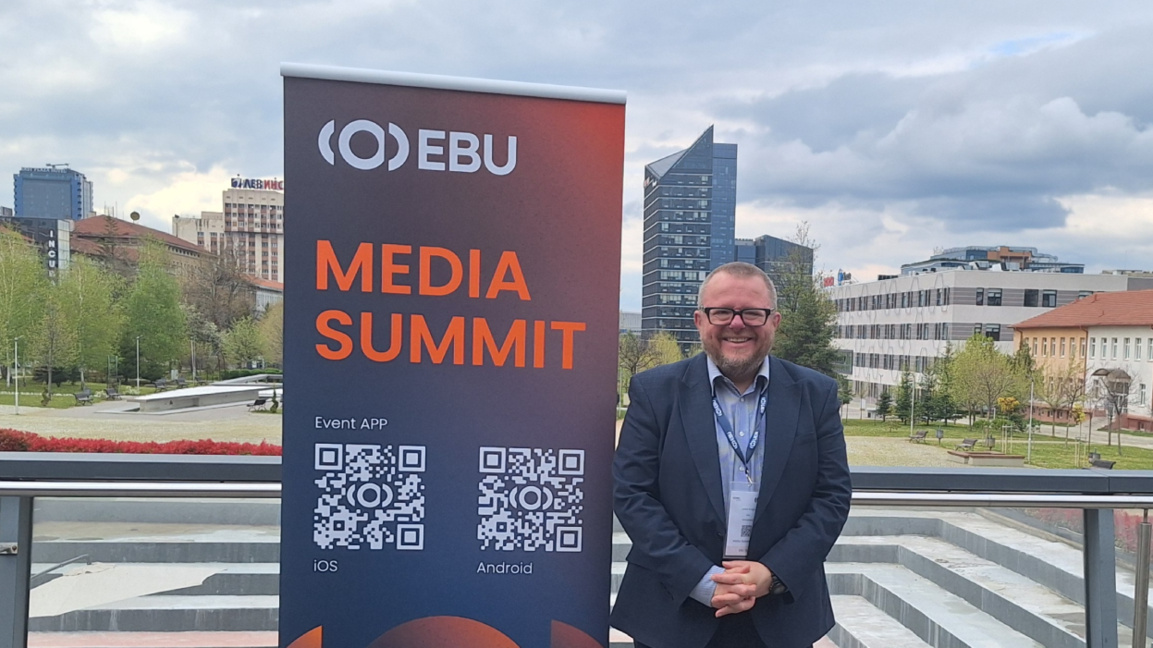
EBU Academy head Justin Kings at EBU Media Summit 2026 in Sofia Tech Park
PHOTO Rositsa Petkova
Font size
For the first time, the Bulgarian capital Sofia is hosting the EBU Media Summit 2026, bringing together leading voices from across Europe’s public service media to discuss some of the most pressing challenges facing journalism today. Among the key themes of the forum co-organized by the Bulgarian National Radio and the Bulgarian National Television are trust in public service media (PSM) in an unstable global environment, the role of media in times of crisis, and the opportunities and risks posed by artificial intelligence.
Bulgarian public broadcasters host European Media Summit in Sofia
Public media from all over Europe gather at a forum in Sofia
In a rapidly evolving and often chaotic information environment, trust remains the cornerstone of public service media, says Justin Kings, Head of the EBU Academy, one of the forum delegates. A senior media professional with more than 30 years of experience in British radio stations including Capital Radio in London and BBC London and leading one of the corporation’s first multimedia newsrooms, he’s been specializing in social media, constructive journalism, and digital transformation in recent years.
Public broadcasters are key to democracy, Bulgaria’s president says
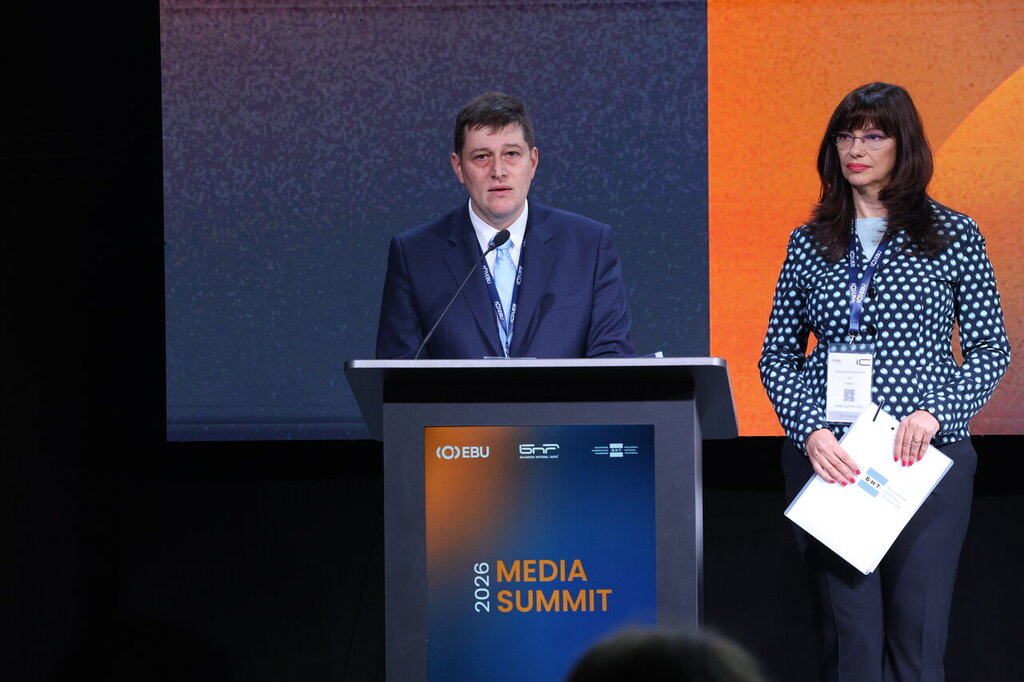
The Director General of the Bulgarian National Radio (BNR), Milen Mitev, and the Director General of the Bulgarian National Television (BNT), Milena Milotinova, at the EBU Media Summit at Sofia Tech Park – April 22, 2026.
PHOTO Ani Petrova
“I think the role of public service media in terms of maintaining trust is absolutely crucial because we live in a time where we know audiences are accessing information from all sorts of platforms, including social media,” he said. “At any one time, I’m sure we’ve all seen examples of misinformation and disinformation. So for any citizen to know that they can rely on their public service media organisation to be delivering information that they can trust, particularly at a time of so much tension and uncertainty around the world, is absolutely crucial.So I think at this time in our lives, the role of organisations like BNR is absolutely crucial.”
According to him, this responsibility places public broadcasters at the heart of democratic societies, especially when audiences are overwhelmed by unverified content online.
Kings underlines that credibility today depends not only on accuracy, but also on speed and transparency in verifying information.

PHOTO Rositsa Petkova
“The role of public service media journalists is to be skilled in quickly being able to verify the accuracy of, the latest viral video that's claiming something's happened in the middle of Sofia or any other city or town within Bulgaria, and then to be able to use strategies to be able to quickly decide whether, yes, this video is what it claims to be, that it's genuine, or know that it's not. Then I think there's an extra layer, which is sharing with audiences the work that's done. So audiences understand, first of all, from a media literacy point of view, that not everything they see can make guarantee is accurate and correct. But also for them to understand that this is one of the roles of public service media in our times - to be highly skilled, to be able to fact check and to be able to verify the accuracy of information. That’s a huge role for public service media, newsrooms and journalists."
Crisis preparedness and response were central to the discussions in Sofia. Kings emphasized that in moments of uncertainty, audiences turn to trusted sources more than ever.
“When there is a crisis, when there is no power in Bulgaria, or when there is any kind of threat facing the country, the one thing audiences need is information, reliable, accurate information that they can trust in. So to know that there is an organisation that they can go to with accurate, fast, usable information in any time, in the time of any crisis is essential. I think the role of radio is particularly important when it comes to crisis. Let's say there is a complete blackout of power, no power in across parts of Bulgaria for hours and hours on end. Well, your Wi-Fi is not going to work. Can you rely on your data connection? I don't know. But your FM radio, particularly if it's battery powered or you're in your car, some people still have those, emergency kind of wind up radios. Radio is resilient as a technology and having all that trusted, reliable information on there is critical.”
The EBU Academy led by Justin Kings since November 2023 is actively working to equip journalists and media organizations with the skills needed to respond to modern challenges - from physical safety to cybersecurity.

PHOTO freepik.com
“The work that we've been doing makes you realise just how broad a topic it is, how broadly you need to be prepared in so many different areas. So for example, for many years we've run what we call hostile environment safety training. So this is all about keeping journalists safe. Traditionally it was about journalists that were going to war zones, war reporters taking this kind of training. But increasingly we're seeing not just wartime journalists, but all journalists needing to make sure that they know how to protect themselves and how to protect their crew, be in a war zone or in a domestic situation. Then we're talking about topics like cybersecurity. So moving away from journalism, thinking about the role of engineers and IT specialists who work within public service media. So navigating cyber security and ensuring that the systems that sit within BNR or any other public service media.’
Artificial intelligence is another focus of the summit. While acknowledging the risks, Kings pointed to the growing role of AI as a tool for journalists.

PHOTO academy.ebu.ch
“One of the risks is around people, whether it's bad actors or whether it's just members of the public. Maybe without any bad intention, using AI to create misinformation and disinformation. So certainly, that's one of the added pressures, should we say, that AI is giving newsrooms and teams that are working on verification. On the flip side, AI is allowing them to use new tools to be able to fight this sort of war against misinformation”.
Think of it as, you could be working on your own, out on location, but you could ask a large language model like ChatGPT for certain ideas about covering a certain story or it can help manage large amounts of data. So for investigative journalists who need to look into a lot of data to be able to cover a story, to look at trends over a long period of time, very detailed information, which might actually take quite a long time to work through manually, artificial intelligence can help process that really quickly.
Through its School of AI, EBU is helping journalists adopt these technologies responsibly. Kings stressed the importance of maintaining human oversight:
“There's lots of positive applications and we see public service media using them. I think, but yeah, we have to use it with care. If you're using it as a research tool or to process information, there needs to be a human who's there to be able to check what comes out at the other end. So we call it the importance of the human in the loop.’
He also encouraged journalists to embrace the technology while remaining critical:
“I think what's absolutely essential for every journalist is a basic level of AI literacy - understanding what artificial intelligence is, what generative AI is. And the reason why I think just that a good general knowledge of artificial intelligence is crucial is because that's going to help the audiences. It's going to help raise the audience's level of AI literacy. So I think for every journalist that is a given now. AI can help you, can help you take away those mundane tasks, do interesting new things. So I would encourage you to learn about these tools and take up as many opportunities as you can to be trained and to be educated.’
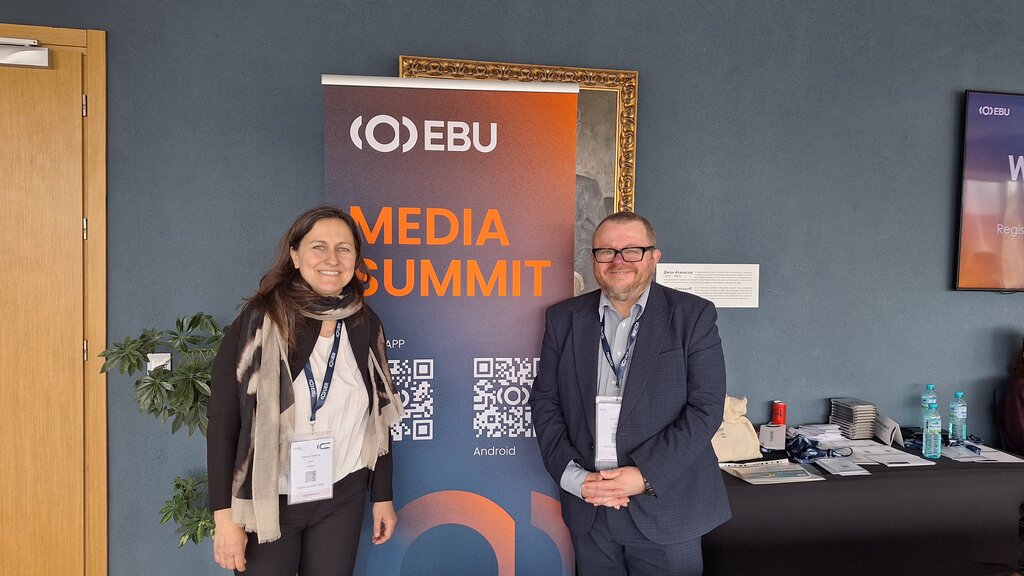
Justin Kings with Radio Bulgaria's Rositsa Petkova
PHOTO Rositsa Petkova
Hosting the EBU Media Summit for the first time, Sofia has positioned itself as an important hub for media dialogue in the region.
“The fact that we’ve got so many of Europe’s public service media here in Sofia makes a very positive statement,” Kings said. “The organisation has been fantastic, and on a personal level, I always find Sofia a wonderful city.”
As discussions at the EBU Media Summit 2026 continue, one message stands out clearly: in a world of uncertainty and rapid change, trusted, responsible, and forward-looking public service media remain essential.
Read also:
Media expert Justin Kings: how to use social media in radio journalism
Edited by E. Karkalanova
This publication was created by: Rositsa Petkova