


News
7 May - Radio and Television Day
Modern media in the battle for the audience’s trust
“Trust defines the quality of media today,” says Sergey Stanovkin
Thursday 7 May 2026 09:44
Thursday, 7 May 2026, 09:44
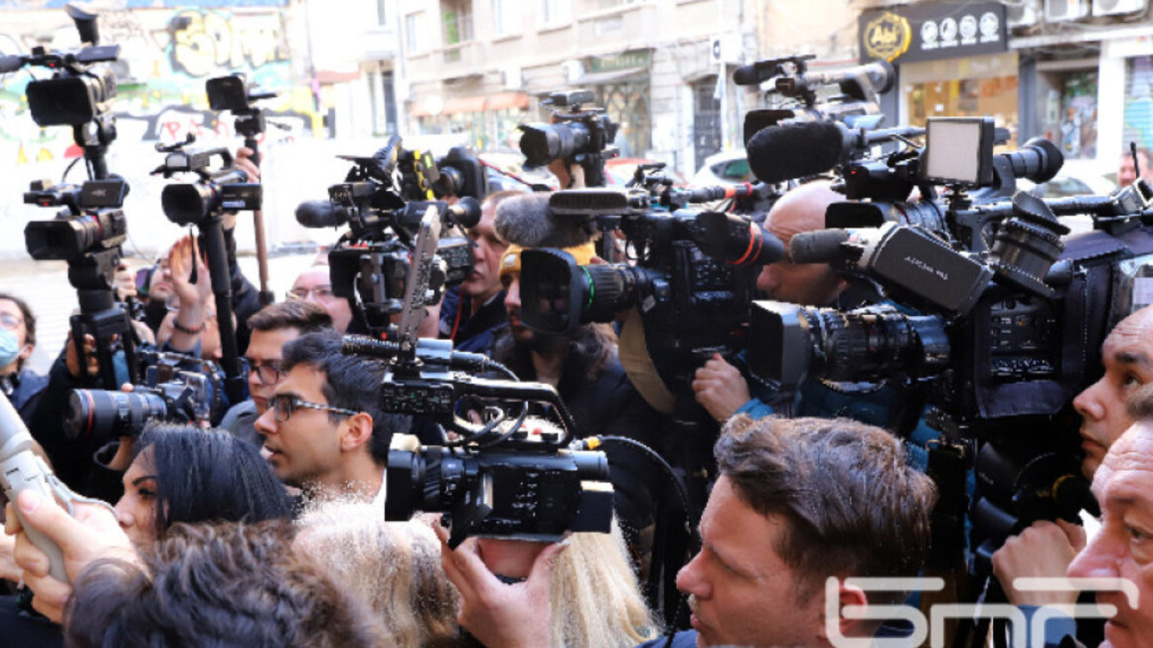
PHOTO Ani Petrova
Font size
For decades, 7 May in Bulgaria was celebrated as Radio and Television Day, marking the first public demonstration of a radio receiver by Russian physicist and engineer Alexander Popov in 1895.
To this day, many radio and television journalists continue to regard the date as their professional holiday and exchange greetings on the occasion, although the official World Radio Day established by UNESCO is observed on 13 February. The tradition of radio and television journalists celebrating 7 May as their professional day became firmly established in Bulgaria in 1968, when the date was officially designated for the occasion. The choice is linked to the historic event of 7 May 1895, when Alexander Popov demonstrated the first radio receiver - a device for transmitting and receiving electrical signals wirelessly over long distances - before the Russian Physical Society in Saint Petersburg. From one hall to another, Popov transmitted the message “Heinrich Hertz” in memory of the German physicist who had died the previous year.
But what is the world of electronic media like today, and what are the contemporary challenges facing it?
Radio Bulgaria spoke with Sergey Stanovkin, commercial representative of BBC News for the Eurasia region His professional career also includes developing the educational programme Modern Media for BBC Academy, focused on transforming national broadcasters and creating internationally competitive television channels in an increasingly global media environment.
- Hello, Mr Stanovkin. To begin, could you tell us a little about yourself - where did your interest in the media come from, and how did your journey with the BBC begin?
- I graduated from the Faculty of Physics and Space Research at the Moscow Institute of Physics and Technology. However, I always read newspapers and was fascinated by learning about different countries through the media. I was also eager to understand how a country’s image is shaped through the media and why the media wield such enormous influence over the way nations - and companies - are perceived around the world.
I suppose this interest in news materialised in some way when, at the end of 2005, I was offered a position as a representative of BBC World News in Moscow, responsible for commercial and partnership projects for the television channel. At that time there were still no advertisements on BBC.com; advertising on the website was only authorised by Parliament in 2009. But I began working with the BBC in January 2006. The offer came completely unexpectedly and perhaps because I had already been involved in international communications, actively working both in Asia and in Europe, my work had somehow attracted attention.
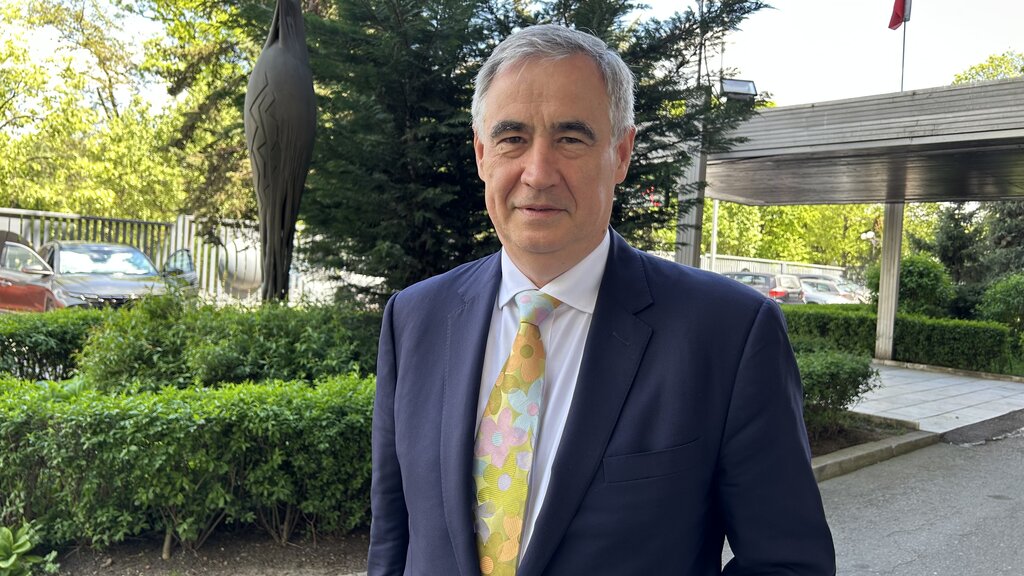
Sergey Stanovkin
PHOTO Krasimir Martinov
- What are the main challenges facing the media in today’s world? In the countries in your region of responsibility, they are hardly the same…
- There are differences and specific challenges in every country. For example, in many regions, media outlets try to attract attention mainly through negative news. This often drives audiences away. Yes, each country is a separate case. But the common and fundamental issue for all of them is trust - the trust of the audience. This is the key factor that determines both audience growth and the growth of the media itself, as well as its overall quality. Only after that can we talk about audience segmentation by interests, competition between different formats, and so on.
- In your view, how should a media organisation build its image in order to earn trust?
- First and foremost, you must pay attention to your audience, not focus on yourself. You need to understand who your audience is and work for them, rather than for yourself. For example, if people are interested in the weather forecast before they leave home, but cannot find it with you, they will go elsewhere and switch channels. If your audience is interested in economic news, but you only offer cultural or historical stories, they will turn to alternative sources of information.
That is why information must be both timely and presented in an engaging format - one that the audience is willing to use. And here we are talking about competition. In media, competition is no longer just regional; it is global. For many people, language is no longer a barrier, as technical tools allow for rapid translation. What matters is the substance of the information and how competitive its presentation is - how complete and comprehensive it is. Only then does trust begin to emerge: first in the information itself, and then in the media outlet.
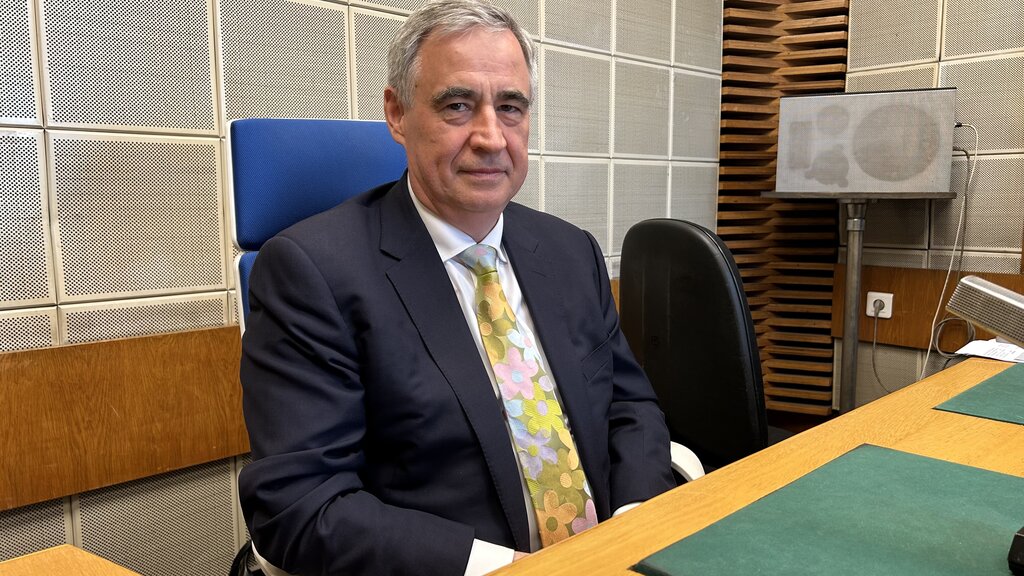
Sergey Stanovnik in Studio 39 of the Bulgarian National Radio
PHOTO Krasimir Martinov
You are referring to one of the largest media markets in the region - 17 countries in Eurasia. How can a media brand be successfully built in such a context?
– If we are talking about a media brand, then we are most likely referring to a corporate brand, and like any corporate brand, it is tied to a specific industry. It is also connected to a region or a country. And often, many corporate brands find it difficult to position themselves. A media brand is either international or national. If it is national, then one has to consider who it is competing with.
Competition is a crucial factor, because you are competing for the attention of the audience. If you broadcast, for example, in an audio format, your audience may already be ready for video content - or vice versa. If we focus on audio formats, then you may have unique competitive advantages that you can realise - for instance, through a podcast that people can listen to in the car, on the metro, or in other situations where watching video is difficult.
But a brand is an image, and branding is a process - a process of communication with the target audience, aimed at building unique competitive advantages. Every word here matters. What is a target audience? You need to know who your audience is - not just how many people listen or watch you, but whether you actually meet their needs.
The second point is how you communicate with that audience, how you present your unique advantage. Media organisations often think this is unnecessary, that it happens automatically - that if you have an audience consuming your content, they will naturally form a positive perception of you. Yes, they might - but that perception is then not shaped by you, and often develops without your involvement. And that is, of course, not right.
Because a brand is a stable image. Ultimately, it must be a consistent, vivid and attractive image. And for that, you need to give it a certain texture, to create specific associations - when your media brand is mentioned, clear associations should immediately arise: trust, completeness of information, uniqueness, depth of analysis, interesting presenters, and so on.
These associations are extremely important for a media brand. That is why, like any other company, media organisations must also work on promoting their corporate brand - not only their products. There is a big difference between corporate branding and product branding. When you promote products, you present a specific segment of content or services, which can also easily be offered by competitors.
That is why these services must be clearly associated with you. Corporate branding also includes aspects of corporate culture. A brand is not just a story, nor only a reflection of the present. A brand is your vision of the future. And if you work on corporate branding, you attract partners who understand where you are heading and how they can align with you on that path.
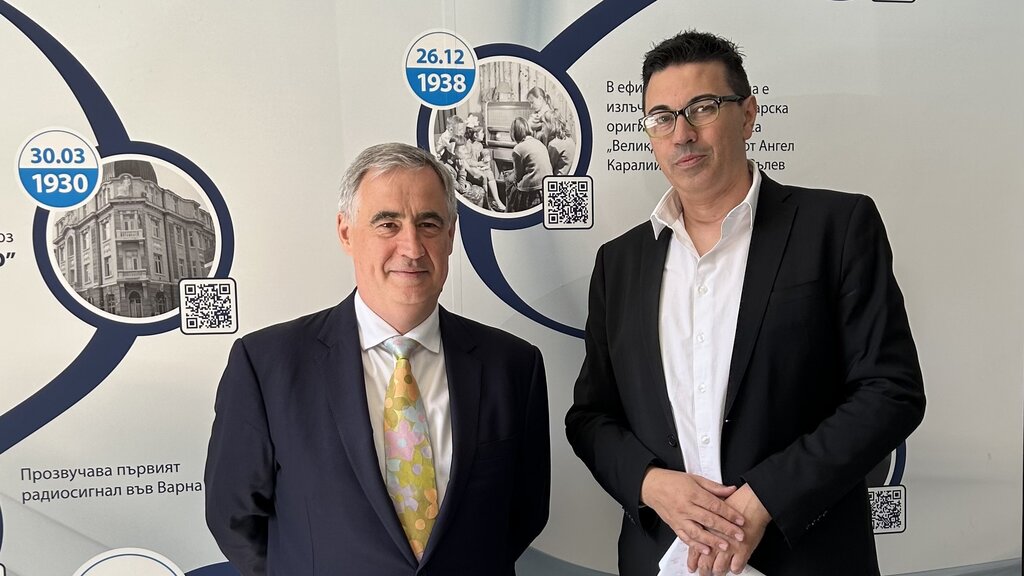
Sergey Stanovkin with the editor-in-chief of Radio Bulgaria Krasimir Martinov
PHOTO Desislava Semkovska
- There are differences in objectives and structures between public and commercial media. What are they in the countries you personally observe?
- You know, for the audience these differences are not that significant. People do not really think about where the money of the media comes from - whether it is from the government, a regional authority, or a private sponsor. Those involved in politics, yes, they probably go into such details and are more concerned with them. But if we speak about the majority of the population, about the audience as a whole, they often do not consider how media are funded or who owns them. If you think it is important to emphasise your connection to the state, you can do so. If, on the other hand, it is important for you to appear dynamic, fast and adaptive, then you present yourself as a corporate or private media outlet.
There are programmes worldwide and in Europe supporting private media - and Bulgaria is part of Europe. But there are also programmes supporting public media, because public broadcasters perform a very important function.
Is there competition? Yes, there is. But what is the competition about? Probably not about funding, but about the attention of the audience. And here we come to the key question: what is, in fact, the result of media activity? In the end, you can measure how many sponsorship packages or advertisements you have sold, or you can measure how your audience has grown - for example during election coverage. Because in important moments in a country’s history, everyone turns to sources they trust.
And that is where you can monetise trust. But you must clearly understand your strengths and weaknesses. And therefore, you should always compare yourself - but this comparison, I would emphasise, is not only at a national level. For example, elections in Bulgaria are covered by all major international media, not only Bulgarian ones. And here we are talking about your target audience. If your target audience, for instance, consists of influential and educated people, it is entirely possible that they will have followed the elections through international media coverage. Why? Perhaps because those sources inspired more trust? And here there is a wide field - on the one hand for creativity, for research, and on the other hand for strengthening every element of corporate branding.
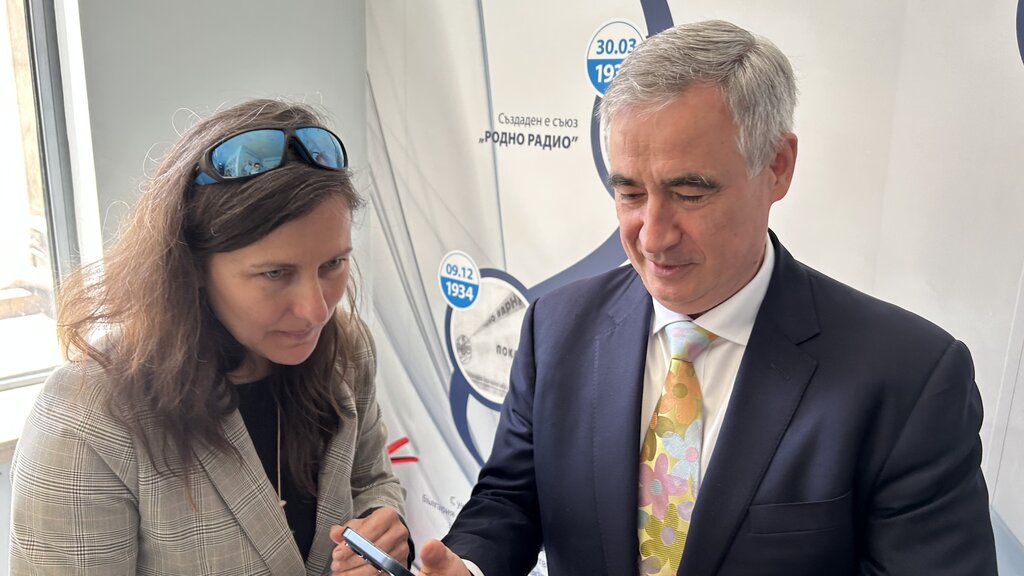
PHOTO Krasimir Martinov
What is your personal interest in Bulgaria at the moment? What do you know about our country, and what is its potential in the field of media - and beyond?
- The potential is very significant. In my view, it has not yet been fully realised. Bulgaria has gone through so many transformations – both politically and socially. In recent years, a rather persistent mindset has taken hold: “We will wait.” And the country finds itself in a continuous state of anticipation.
Phrases such as “we still do not have a regular cabinet” or “when we have a stable government…” have spread into the corporate sphere as well, and from there into people’s behaviour. Yet, somewhat paradoxically, it is precisely in such conditions that it is often easiest to start something new. Because each concrete project is perceived as a “wow” factor - “look, someone has decided not to wait!”
In the past, there was a saying that a problem can be solved in different ways, and if we do not solve it, it will eventually disappear on its own. And so, on the one hand, Bulgaria appears to me as a country where a new beginning is emerging. In many European countries, that beginning has already happened. Here, it feels like yet another new beginning.
On the other hand, Bulgaria occupies a very important geographical position – not only geographical, but also geo-economic. The industries are developed, yet very little is known about Bulgaria internationally. And most often, the country is discussed in the context of internal political developments, rather than international or economic ones. It seems to me that corporate branding at the company level in Bulgaria is still in its early stages. Therefore, there is a very large field for development.
As for the level of education in Bulgaria, it is very high. And this desire and capacity to create something new is clearly expressed in the startup culture, which is very active and visible. Much is said about it, but here too there is a tendency towards inward focus, rather than focusing on the target audience and explaining why and for whom what they are doing matters.
And this is where there is significant room for improving the quality of communication - so that it is not just large-scale and frequent, but genuinely high-quality. Quality means being competitive, having depth, being distinctive and presented in the right format. And most importantly - being directed at the right audience.
Read also:
Justin Kings, EBU: The role of pubic service media in times of crisis is crucial
Edited by Elena Karkalanova
This publication was created by: Rositsa Petkova