


Author
Irina Nedeva
Interview
MEP Dan Barna: Bulgaria must clearly name Russia’s aggression in the Black Sea
The EU will accelerate the creation of a European Martime Security Center
Friday 23 October 2026 14:58
Friday, 23 October 2026, 14:58
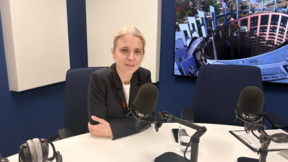

MEP Dan Barna in Radio Studio 2 at the European Parliament in Strasbourg
PHOTO Irina Nedeva
Font size
The Black Sea is no longer merely a trade corridor. It has become a test of European security. In a resolution adopted on Thursday, the European Parliament expresses solidarity with Bulgaria and Romania over the escalation of Russian attacks on commercial shipping, while also voicing serious concern about “the unclear and ambiguous response of the Bulgarian authorities to the escalating Russian threat in the Black Sea”.
How does the Romanian government view the response of the Bulgarian government led by Rumen Radev to Russian threats in the region? And how can Europe protect shipping in the Black Sea without waiting for the next attack? Is a common European response possible when national governments are sending different signals to Moscow?
In Strasbourg, BNR's Irina Nedeva spoke to Romanian MEP Dan Barna, a former deputy prime minister of Romania and one of the driving forces behind the resolution on behalf of the Renew Europe group. Their conversation addressed the need for a European Maritime Security Centre, the protection of commercial vessels, and the role of Bulgaria and Romania in defending NATO’s eastern flank.
But there is also a broader question facing the EU: can Europe finance its defence, maintain support for poorer regions and avoid new political crises within the Union at the same time?
You are calling for a European maritime security centre in the Black Sea. What exactly should this centre do, who will fund it, and when could it become operational? Is there not a risk of creating yet another institution while ships continue to come under attack?
“This resolution is also a very swift response by the European Parliament. I am pleased that, on the very day it was debated in the European Parliament, NATO also brought the Black Sea into focus. The resolution has two main objectives. The first is to recognise the need to designate the Black Sea as a priority area on the eastern flank. The second, as you rightly pointed out, concerns the establishment and funding of a European Maritime Security Centre.
The purpose of this structure, this centre, is to enhance the capacity to respond rapidly to attacks and security threats in the Black Sea. War is no longer just a war of tanks and aircraft. It is a drone war, and in this kind of warfare, time is of the essence. That is precisely why this centre must strengthen NATO’s and the eastern flank’s ability to respond appropriately and in a timely manner. What we are talking about is building technical infrastructure capable of addressing the realities of Russian aggression.”
Romania and Bulgaria are directly exposed to these risks, but the Black Sea is also an external border of both the EU and NATO. What concrete action do you expect from European partners: military surveillance, air defence, escorts for commercial vessels or some other form of presence?
“Everything you have mentioned is important. I mean the ability to identify risks and drones in a given area as quickly as possible. It is also important to have the capacity to scramble aircraft to destroy these drones. In this context, I would like to commend the Romanian and Spanish pilots who have managed to shoot down several drones in recent days. In the near future, we may also have to address the need to protect commercial vessels and provide them with escorts if Russian drones continue to operate aggressively in the region.”
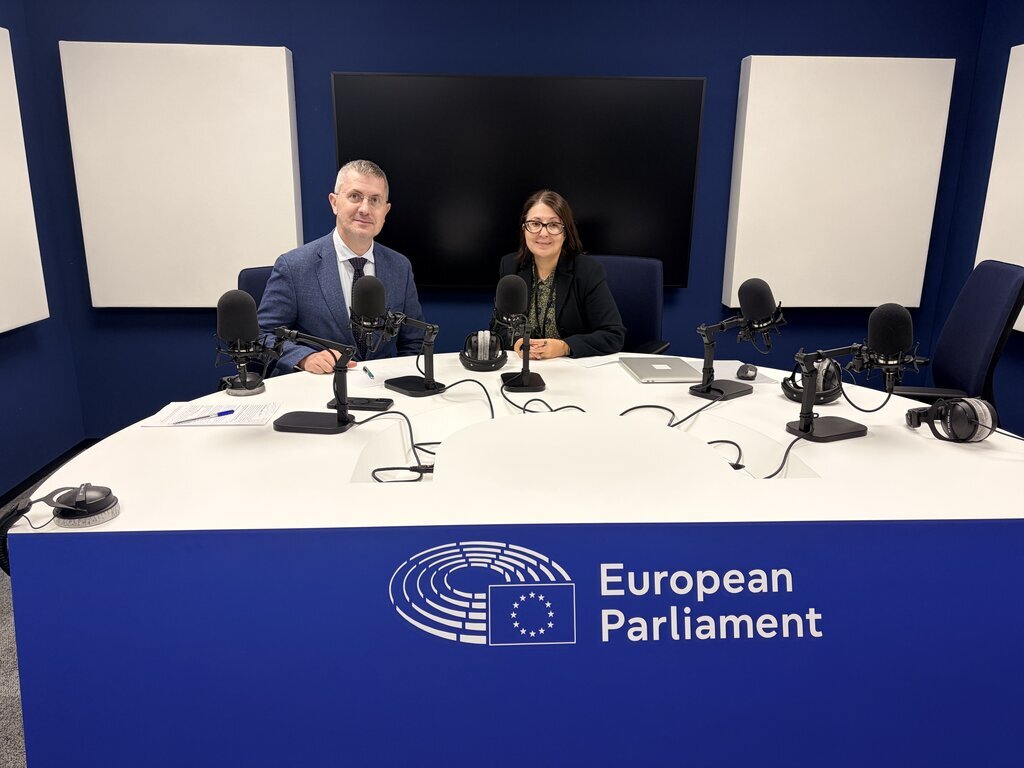
Irina Nedeva and MEP Dan Barna in Radio Studio 2 at the European Parliament in Strasbourg
PHOTO Rositsa Petkova, BNR
Romania has clearly identified the aggressor. For the first time, Prime Minister Rumen Radev has mentioned Russia as being logically linked to the attacks, while adding that there is no evidence confirming their origin. From Romania’s perspective, how do you view the Bulgarian government’s response?
“We must be absolutely clear, and this resolution emphasises the point: Russia is the aggressor and is carrying out attacks against NATO’s eastern flank, including against Romania and Bulgaria. The text of the resolution, which we agreed on only yesterday, also refers to the perception that Bulgaria’s position is unclear and insufficiently categorical. I am optimistic that the Bulgarian government, too, will demonstrate solidarity and determination by acknowledging that these attacks originate from Russia and that a coordinated response is needed.This is one of the main problems associated with these attacks.
Commercial shipping is crucial not only for the countries of the Black Sea region. Food and essential goods are transported by sea to Africa, Asia and many other countries that depend, for example, on Ukrainian grain. The key question is how to protect this commercial traffic. If the Black Sea were to become a situation resembling that in the Strait of Hormuz, brought about by the war with Iran, this would put enormous pressure on the gas and hydrocarbon markets. Agricultural products could also be seriously affected.”
You advocate both stronger European defence and continued support for cohesion policy and agricultural subsidies. When resources are limited, who should make the compromise? Can countries such as Romania and Bulgaria expect more funding for security without losing support for their regions?
“Europe is under intense pressure from anti-European, sovereigntist and extremist movements. Weakening cohesion policy is precisely the argument used by sovereigntist and pro-Russian forces. They are trying to convince European citizens that Europe no longer works. That is why cohesion policy acts as a bond holding European values and European solidarity together. For this very reason, I believe it is important, for Romania, Bulgaria and Europe as a whole, that cohesion policy remains in place and continues to be strong.”
Romania is emerging from nearly six months of political deadlock with a minority government. Is this a temporary arrangement, or are there grounds to expect stability?
“The outlook is relatively optimistic in terms of stability, though not necessarily in terms of the quality of governance. Romania is currently facing a similar situation within its government, and I am sure Bulgaria has been through many such situations as well. We are talking about parliaments divided into three roughly equal blocs, none of which is willing to work openly with the other two. Yesterday, parliament approved a new government. So we now have a new cabinet. That is good news for the country’s stability.”
You have criticised the lack of tangible progress on enlargement. Is the EU ready to admit Moldova and other candidate countries before reforming its own decision-making processes? And how would you prevent a scenario in which new members bring unresolved rule-of-law problems into the Union?
“I must express my deep respect for Marta Kos, the European Commissioner for Enlargement, because she has managed to turn enlargement policy into a consistent and effective one. Two weeks ago in Strasbourg, she announced the new enlargement strategy, under which the four most successful and best-prepared countries were given roadmaps. This is a significant step forward. I am referring to Montenegro, Moldova, Albania and Ukraine. They are receiving roadmaps that set out a clear path forward, with specific conditions and reforms to be completed. These have been presented to their governments. This represents considerable progress because, at the very least, there is now a clear prospect.
I fully agree that Europe needs reforms, including to its voting system and the way its decision-making mechanisms operate. These reforms must prevent a repeat of what happened with Hungary and Viktor Orbán, when Russia managed to block one link in the chain and bring the entire mechanism to a standstill. To avoid this negative experience and this vicious practice, it is clear that Europe must move towards qualified majority voting instead of the current requirement for unanimity.
As regards enlargement, one approach under the new strategy is to retain unanimity only for the first and final stages of the process, while applying qualified majority voting to the intermediate stages. We are working in this direction, too. I am also a member of the European Parliament–Moldova Parliamentary Association Committee. We are working to help the country carry out the necessary reforms.”
Bulgaria is already in the eurozone. When will we stop having to convert our currencies as two neighbouring countries?
“For us Romanians, and for me personally, this is a painful issue. I would like to congratulate Bulgarian citizens, politicians and society on managing to adopt the euro, despite changing seven governments in roughly two years. The fact that all these governments managed to maintain the course and meet the convergence criteria, enabling Bulgaria to join the eurozone at the beginning of this year, is a source of pride.
I know that Romania and Bulgaria have a healthy sense of neighbourly competition on various issues. I know many people on both sides who take pride in their country’s achievements, in the areas where Romania excels and those where Bulgaria performs well. But when it comes to the euro, you have done better than we have. You have my admiration.”
Irina Nedeva’s full interview with MEP Dan Barna was aired on the 12+3 programme on BNR's Horizon channel.
This publication was created by: Rositsa Petkova