


Author
Vesela Krasteva
News
A German student explores the depths of the Bulgarian language
“Bulgarian is the most fascinating of all Slavic languages,” says Leonid Motz, named best Bulgarian studies student at the University of Vienna
Sunday 24 May 2026 07:35
Sunday, 24 May 2026, 07:35
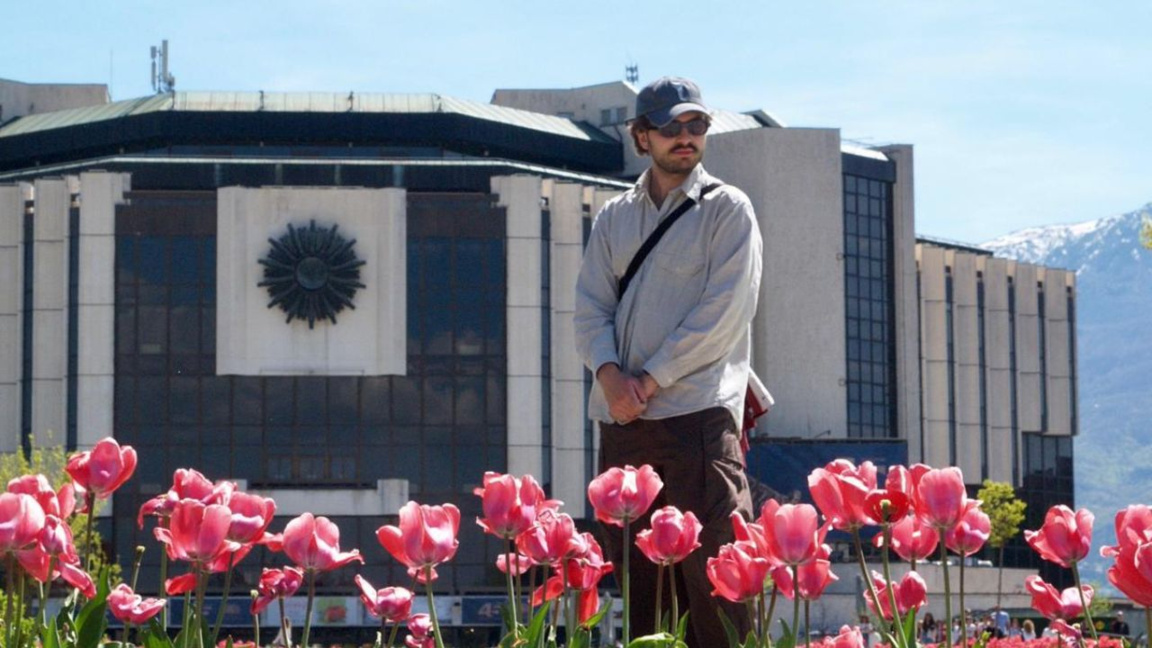
PHOTO personal archive
Font size
As Bulgaria celebrates May 24 — the Day of the Bulgarian Alphabet, Education and Culture — and still basks in the Eurovision excitement surrounding DARA’s victory with “Bangaranga”, one young Western European has found inspiration not only in Bulgarian music, but in the language itself.
At 24, Leonid Motz spends his days studying the history, grammar and evolution of Bulgarian at the Institute of Slavic Studies at the University of Vienna. Earlier this year, he received the award for Best Student in Bulgarian Studies for 2025 from the Bulgarian Embassy in Austria.
Motz grew up near Stuttgart in southern Germany. He has Belarusian roots on his mother’s side and spent part of his childhood in southern Italy. However, from an early age, he had set his sights on Vienna and studying Slavic philology.

PHOTO personal archive
What surprised many around him was his choice of language. Instead of focusing on Russian, which he already knew well, he immersed himself in Bulgarian — a language he first encountered during a visit to Bulgaria in 2017.
“A friend of mine was studying medicine in Pleven, and that was how I first came to Bulgaria,” Motz told Radio Bulgaria. “I immediately realised the language was incredibly interesting. It’s close to Russian in some ways, but at the same time it has structures you won’t find in the other Slavic languages. That’s why I decided I absolutely had to study it,” he added. “For me, Bulgarian is the most fascinating of all Slavic languages.”
What captivates him most is the language’s grammar and historical development.
“For someone interested in the history of grammar, Bulgarian is fascinating because it preserves structures from the Old Bulgarian period, especially in its verbal system,” Motz explained. “At the same time, the language has evolved in very innovative ways. And then there’s the simplification process too — for example, Bulgarian no longer has noun cases, which makes it very different from the other Slavic languages.”
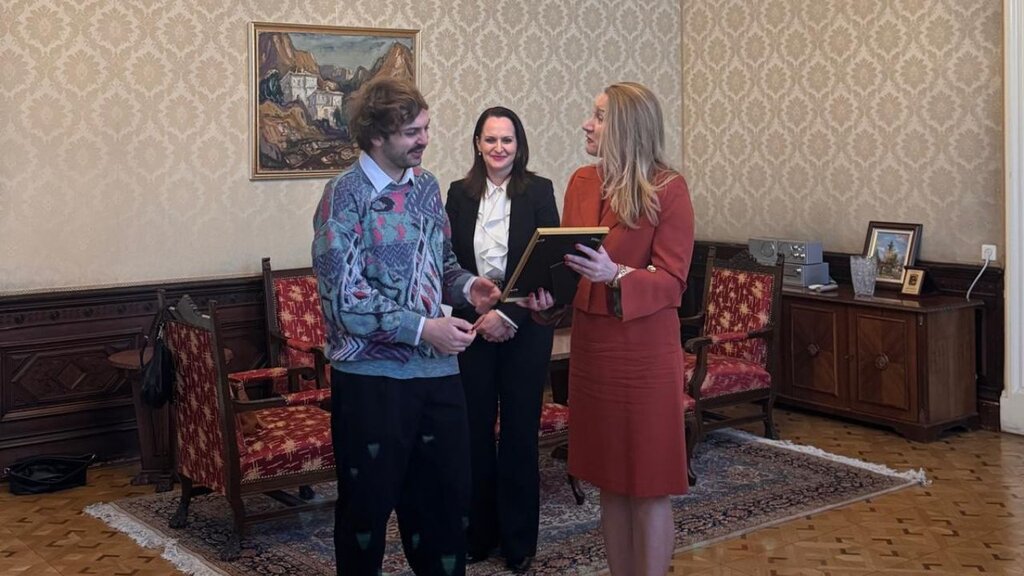
PHOTO personal archive
His interest in the language eventually led him to a long-running competition organised by the Bulgarian Embassy in Vienna. Participants were required to submit a scholarly paper on the evolution of Bulgarian. Motz chose to focus on the writing system of the Banat Bulgarians — a Catholic Bulgarian community with its own dialect and a centuries-old tradition of writing in the Latin alphabet.
“With that paper I won the embassy’s competition, which was a huge honour for me as a Slavist,” he said.
The award later gave him the chance to spend nearly two months at the Cyril and Methodius Research Centre of the Bulgarian Academy of Sciences in Sofia, where he worked with specialised archives and manuscripts.
Motz, who also speaks German, English, Italian, Russian and French, believes less widely studied, or "smaller languages", offer greater opportunities for original research.
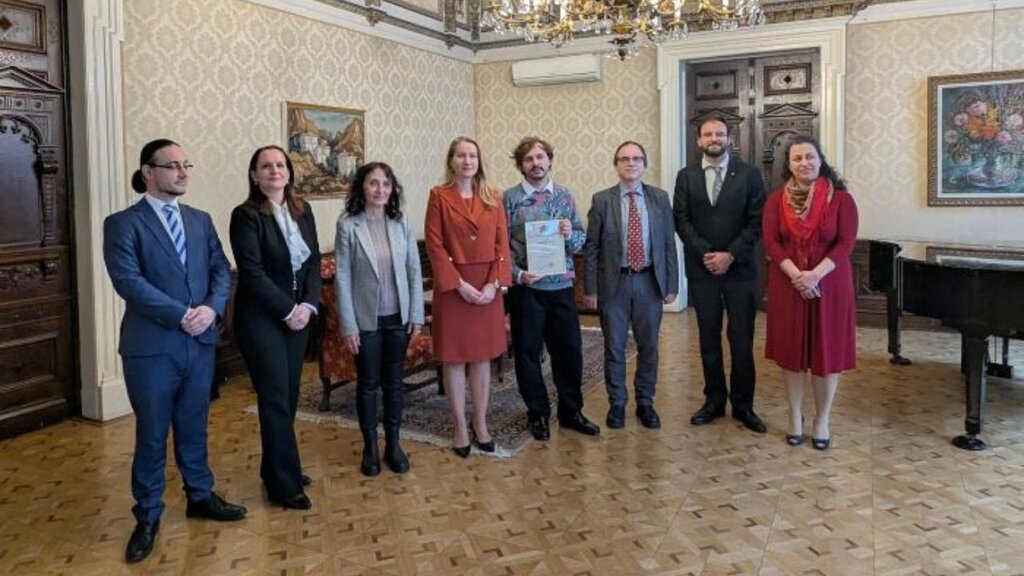
PHOTO Facebook /Bulgarian embassy in Vienna
“When it comes to major languages, almost everything has already been studied,” he said. “With smaller languages, there are still unexplored areas and untouched sources. Bulgarian is especially exciting because there are so many manuscripts that haven’t yet been fully researched.” He hopes to continue working with historical archives in the future and is currently preparing his master’s thesis before moving on to doctoral studies.
Outside academia, Motz is also a devoted Eurovision fan and says he hopes to be in Sofia next year for Eurovision 2027 following Bulgaria’s victory. “DARA’s success shows that if you have talent, determination and the right direction, you should keep going,” he said. “What she achieved is genuinely inspiring.”
For Motz, Bulgaria’s greatest contribution to the Slavic world remains its alphabet and literary tradition. He believes Bulgarians should take pride in their language and continue to study, preserve and promote it.

PHOTO personal archive
He also hopes there will be greater support in the future for people researching Bulgarian language and culture abroad. And despite spending years immersed in grammar and manuscripts, Motz still has a favourite Bulgarian word: “zhivot” — “life”. He laughs at the coincidence that in Russian the similar-sounding word means “stomach”.
So how does he see Bulgarians?
“Bulgarians are very warm, open and positive people,” he said with a smile. “And one thing I’ve noticed is how much Bulgarians love diminutives.” Which perhaps explains why, as he jokingly puts it, “today we’re all just little bangarangas.”
Editor: Elena Karkalanova
This publication was created by: Elizabeth Radkova