


Author
Irina Nedeva
Interview
“Strasbourg Calling" Why is data on data centres' environmental impact missing?
A conversation between Irina Nedeva and Nico Schmidt, a finalist for the European Parliament’s Daphne Caruana Galizia Prize with Investigate Europe
Interview with Nico Schmidt
Monday 26 October 2026 14:21
Monday, 26 October 2026, 14:21

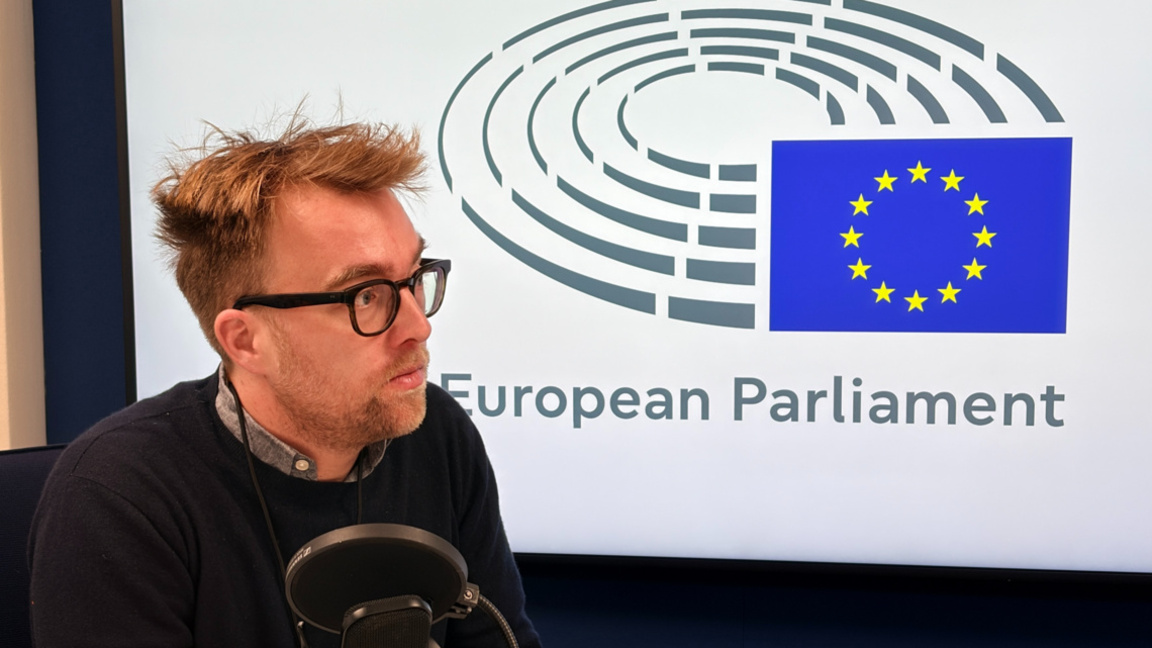
Nico Schmidt
PHOTO Irina Nedeva
Font size
An investigative report has revealed how major technology companies have helped write secrecy into European Union legislation to conceal the environmental impact of data centres. German investigative journalist Nico Schmidt of Investigate Europe spent months examining the “black box” behind Europe’s technology boom and the so-called cloud services industry. The report was among the ten finalists for the 2026 Daphne Caruana Prize for Journalism awarded by the European Parliament.
“We started out wanting to find out what the environmental footprint of data centres was, because the European Commission has this information and collects the relevant data", Nico Schmidt said in an interview for the BNR. "We then examined the legislation relating to this environmental footprint and found that the original legislative proposal did not contain a confidentiality clause covering this information. Under that initial version, various institutions, individuals and organisations could submit proposals concerning the legislation.
Then, in the second version of the legislation, we found that the confidentiality clause had been included. We subsequently examined a letter submitted by Microsoft and the lobbying group Digital Europe, whose members include Meta and Google. We discovered that the wording of the clause had been copied almost verbatim from the letter. We compared the legislative text with the letter from Microsoft and Digital Europe, and they were virtually identical, word for word. Of course, coincidences do happen in life, but how likely is it that this was one?
We spoke informally with members of the European Commission. They were actually afraid that if major technology companies were required to disclose these figures and make them accessible to the public, the companies might refuse to provide them. The question was how the Commission could compel them to do so.”
There is a lack of precise data on the environmental impact of these facilities, Schmidt said in BNR's special programme "Strasbourg Calling":
“We lack data on how much water these centres consume, their exact electricity consumption and their carbon footprint. Another important question is how close they are to operating at full capacity, and whether all these data centres are running at 100% capacity. If they are not, why are there plans to build new ones? For example, we have information about some data centres in France showing that they actually consume less electricity than they could at full capacity, which raises questions.”
Bulgaria has already expressed its intention to attract investment in data centers. Schmidt advised the country to look at Ireland, where the environmental consequences of data centres are particularly visible:
“Bulgaria is certainly not alone in pursuing these plans. Many countries currently see investment in data centres as a sign of progress and innovation. The consequences are most apparent in Ireland. You should look at Ireland. It has the largest number of data centres currently operating in Europe. This is partly for historical reasons, as many of the major technology companies have their European headquarters there. To power their data centres, they are also forced to use natural gas as a fuel, which runs counter to the European Union’s goal of a climate-neutral Europe.”

Nico Schmidt and Irina Nedea at the Radio Studio at the European Parliament in Strasbourg (21 October 2026)
PHOTO Rositsa Petkova
The investigation by the Investigate Europe consortium prompted a response, but the journalist is not optimistic about the eventual outcome:
“Immediately after our investigative report was published, 35 Members of the European Parliament sent a letter to the European Commission calling for the confidentiality clause to be removed. The director of the European Environment Agency also stated that the clause was unacceptable. But it has not been removed.
The issue is not just the influence of major technology companies. It is also about the response of the US government, because whenever the European Union has tried to introduce laws that in some way restrict the tech giants, the United States has intervened with tariffs and retaliatory measures. So, at the moment, I am not very hopeful that real change will happen."
Is “green AI” possible when the EU wants both to lead in artificial intelligence and to be a global leader in sustainability?
“On the one hand, there is the position of the major US technology companies, which insist on keeping this data confidential. On the other hand, European data centre operators want the opposite: they want information about their environmental footprint to be publicly available because they believe they are competitive and could operate more sustainably. But could we have entirely green data centres, or make them greener than they are today? Yes, I believe that is possible", says Nico Schmidt.
A broad consortium of respected European media organisations conducted the investigation, and the story was published on the same day by all media partners including Die Zeit, El País, EU Observer, the Guardian, the Journal, Le Monde, Publico and Tech Policy Press, the journalist explained:
“It required a great deal of coordination and organisation, but for all of us this is an extremely important issue that needs urgent attention. The first step is to expose the secrecy surrounding this data. The second is to continue investigating and producing new reports.”
Read the full report How Big Tech wrote secrecy into EU law to hide data centres’ environmental toll.
Irina Nedeva’s full interview with Nico Schmidt was aired on BNR's Horizon channel and can be heard HERE.